
Dear, you, the user:
Firstly, hello! And how are you today? Since you ought to know that I ought to know that both of us know you cannot relay your response to this question to me (as I do not have a form for... anything — especially user feedback.) — then the ability to percieve rhetoric is an implied pre-requistite and this sentence is recursively a liar.
Do not drink gasoline. Need I say more?
My point is, there's no reason to state the obvious, especially when something is already the mantra by which you live your life.
Did Gandhi have to speak to say words? Yes. This is a terrible analogy. I don't know what it means. Writing this sentence has made me suddenly confused. Let's just move on.
Do Not Drink Gasoline
I seriously do not recommend it. Not that I've tried it. I live what I preach. I tell others not to drink gasoline, and so I also do not drink gasoline.
I'd rather not get feedback, so, let's make a deal. I'll assume you are having a good day and can comprehend english. Good human. And you can assume I'm a good writer who does not ever, not even once in a while, drink any gasoline.
And so, naturally, you'll now realize that you should read this blog.
In fact, it's occured to you that you likely had always wanted to.
Now that you have become aware of your desires,
Let's begin!
p.s. if you really need to contact me tho
Latest: Altermagnets: what the heck are they?
Altermagnets: what the heck are they?
... Who are you, again?
Introduction: where do I fit into the picture?
Over the last month or so I've been working on extending Sitter to support a few different frameworks in physics which will be capable of simulating altermagnets.
My goal with that is not to choose any one direction of research. I think that the field is too new to begin choosing sides. I think it would be more useful to be able to choose all of them, in the same engine, and have the development of altermagnets be able to be tested within each one and see which ones it breaks and which ones agree and where exactly and why exactly for each of them.
I think the collective understanding of each of the frameworks and their expectations, limitations, base assumptions, and biases brought by the fields they are carried from are all useful information. I think none of them are complete, and none of them should be given priority.
One may turn out to be like newtonian physics, and be the most useful when you have room for small errors. There may be constants we have not yet discovered, which could later give us a far more accurate but still less generally useful answer. And to be honest, while I am smart enough to get involved in this part of things, I am not going to be one of the ones who comes up with new theory or math of my own. That's not me.
I can wrap my head around things, and I can fumble my way around the math until I can use it. But I consider differential calculus one of my weaker subjects. I enjoy it, and when it clicks, I thoroughly enjoy the feeling. But it takes everything I have to just understand what others have come up with, so, I will draw my line there. My point being, I have no place in the theory. I will not pretend otherwise.
My skill lies in my ability to understand these things just well enough to be able to use my actual skill: programming. Which gives me my useful niche: if I can understand it, I can create it as a function. I can program anything that I am able to conceptualize well enough to break it down into its simplest pieces that add up to create the whole. So I will not be imposing my beliefs on theoretical physics on the topic of altermagnets. I will be giving YOU a playground to test the theories which dominate the field, and once I've caught up all the way, will continue to add each new development as they come. Those more qualified to have opinions on the topic ought to have some good tools to work with.
I'm hoping to have the honor of giving you Sitter to use as one of these tools. Altermagnetic simulation is a big piece of work, but, stay tuned!
Altermagnets
Like all things worth pursuing, this began with a great question:
Earlier in my week, I had met a fellow programmer and nerd-folk out in the real world (Wowzers!) and we exchanged information and continued talking about nerd stuff. Eagerly, I'd shown her Sitter, and then told her about my plans involving altermagnets. It hadn't ever come up in a conversation before this point in my life. I was unprepared when she asked,
"So... what the heck is an altermagnet? Can you give me the 101?"
I had not been prepared for this question :D To be honest, I'd never talked with another human being about it at all. I wasn't sure where to start. I figured I'd eliminate everything that was not an altermagnet first, and then it would make them easier to explain after...
... it was the inspiration I needed to write this. Thanks for taking an interest, Rachel! I'm very grateful :F
Note: I have simplified certain aspects of how a lot of these things work. These are indicated by footnotes. My goal was to explain the basics in a way that wouldn't overwhelm someone who is learning all of this for the first time. With that said, if you have feedback, I'd be grateful to receive it. Additionally, feel free to email me if you would like to learn more, I can explain either the more technical details, or, elaborate on anything you are interested in knowing more about. I'll probably use it as content for my blog (in spirit, with perhaps your question quoted, with your permission of course), so, it would be mutually beneficial ;F
Here was my reply:
Well, you know how magnets have two poles? If you look at their fields, you’ll see how their flux radiates outwards from them both, rather than from the Poles themselves.
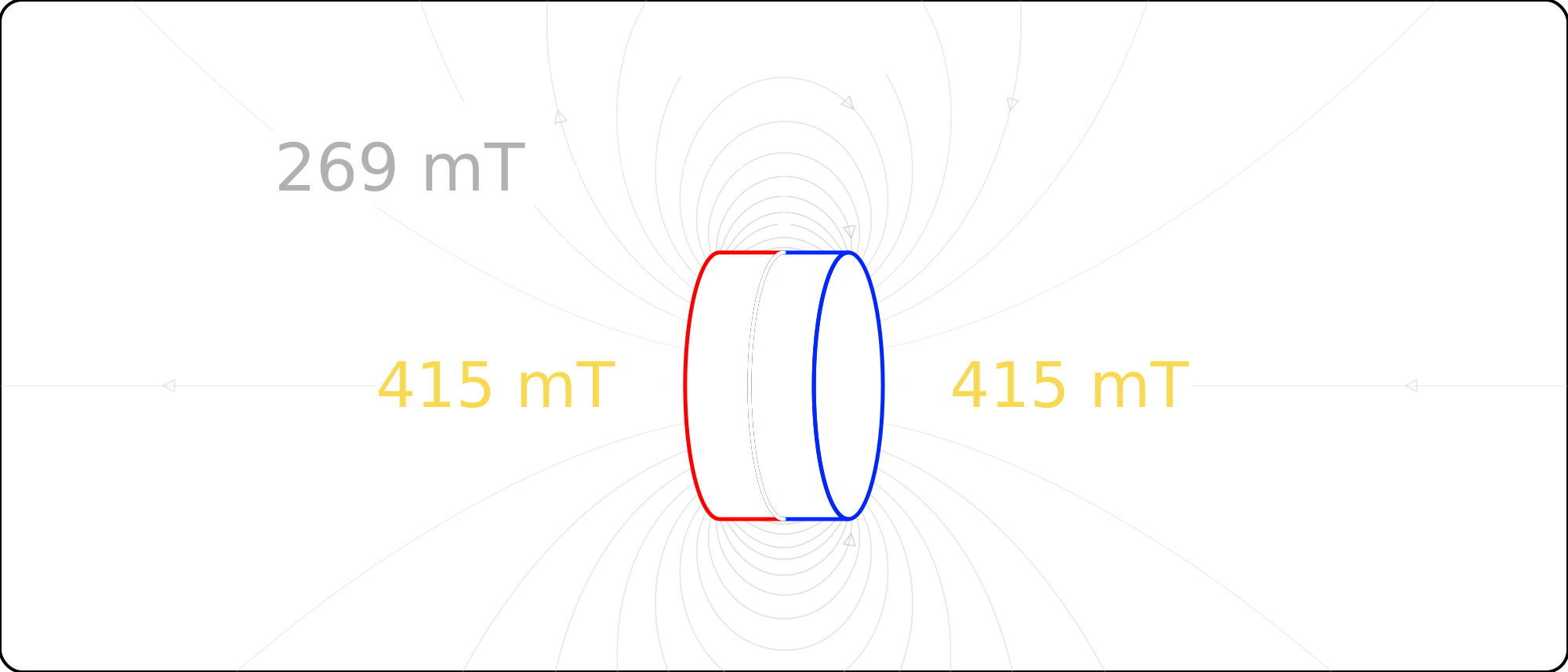
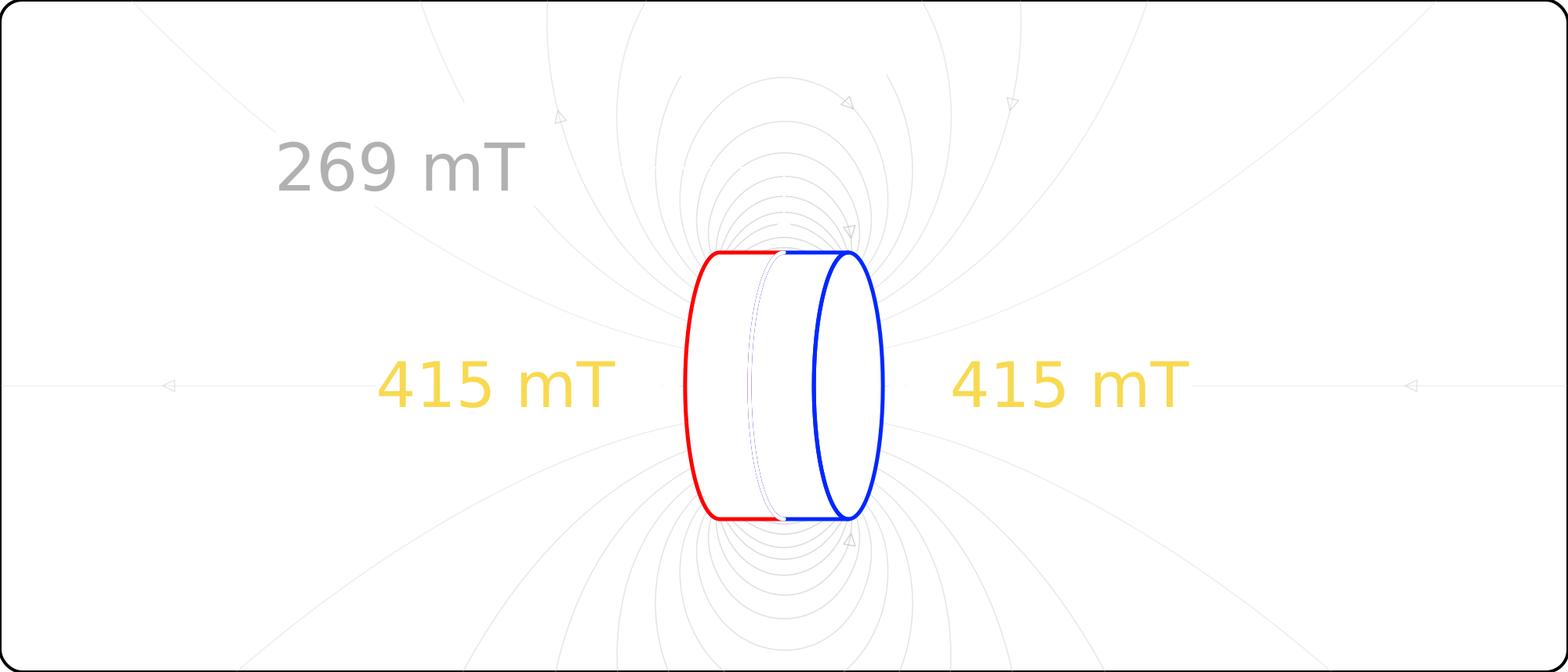
Two magnets stuck together
If you take two flat magnets and stick them together, instead of getting a magnet with 4 poles, you now have a 2-pole magnet[a] that is stronger.[1][2] The middle point[b] is still the weakest part. If you take a bar magnet and a screwdriver, you’ll find the screwdriver is always attracted to the poles much more than to the middle.[2][3][4]
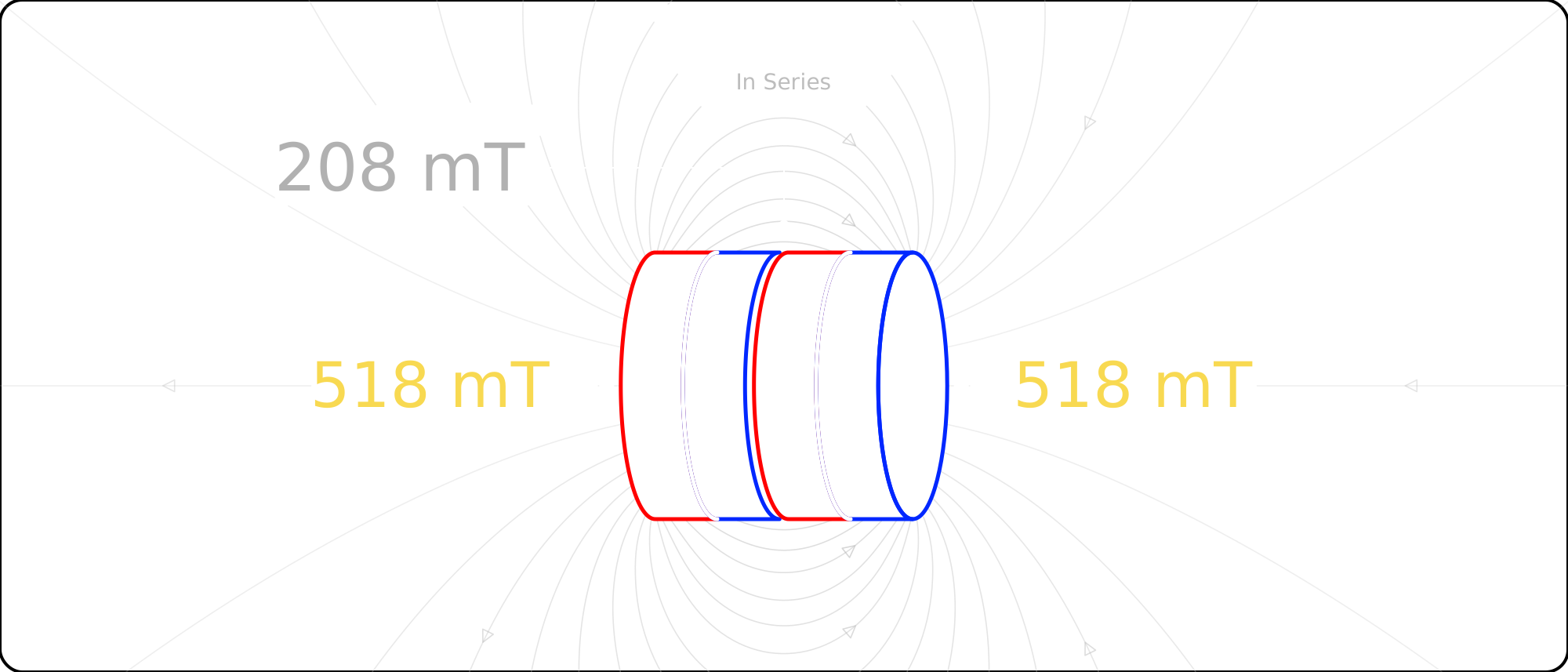
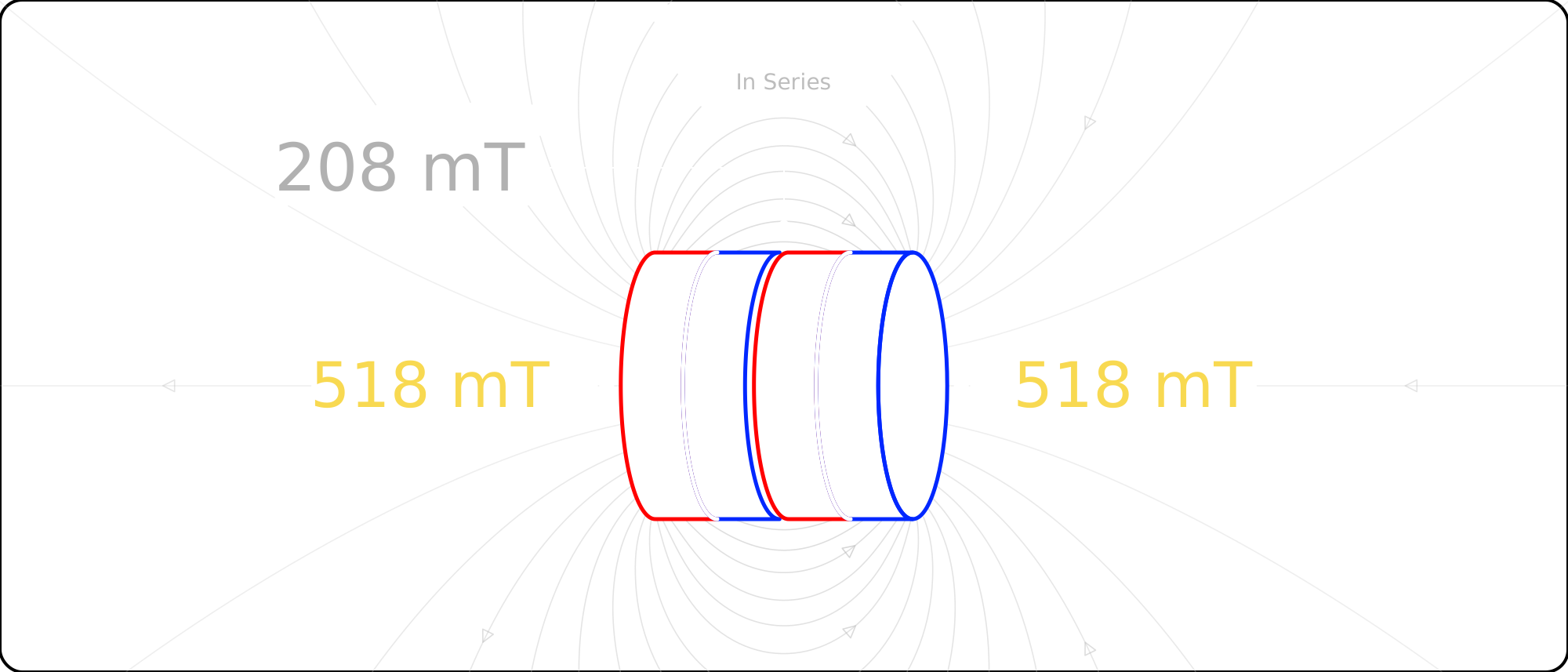
The classical version of an anti-ferromagnet using a coil:
Now, take an inductor or coil.
To create a stronger inductor, you need more windings in the coil going in the same direction. If you start to go the other way around halfway through, and you make the same number of turns, you will have created the coil version of an anti-ferromagnet. This is something which cancels its own magnetic field from the outside, despite having organized current, so very little reaches outward from it. It is organized in an exactly equal and opposite arrangement, so from a distance[c], the net field is 0.[5][2]
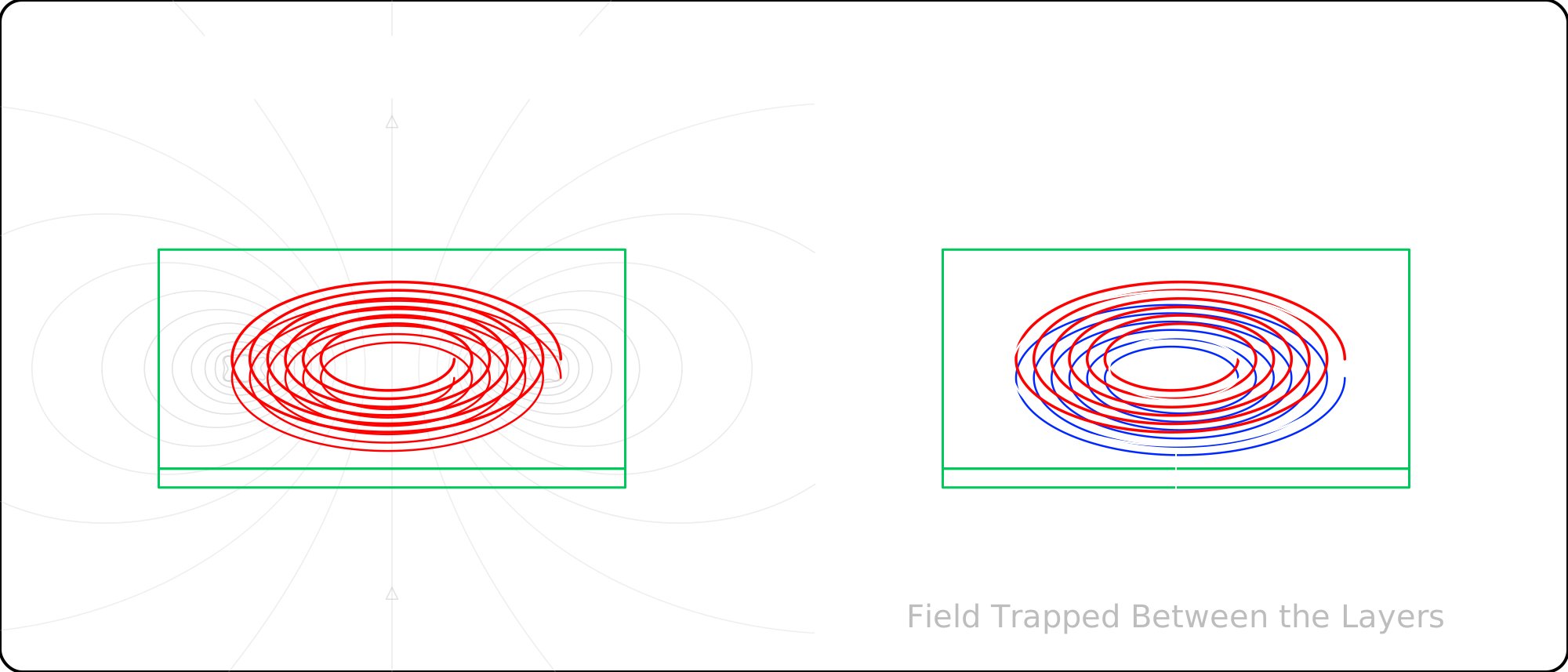
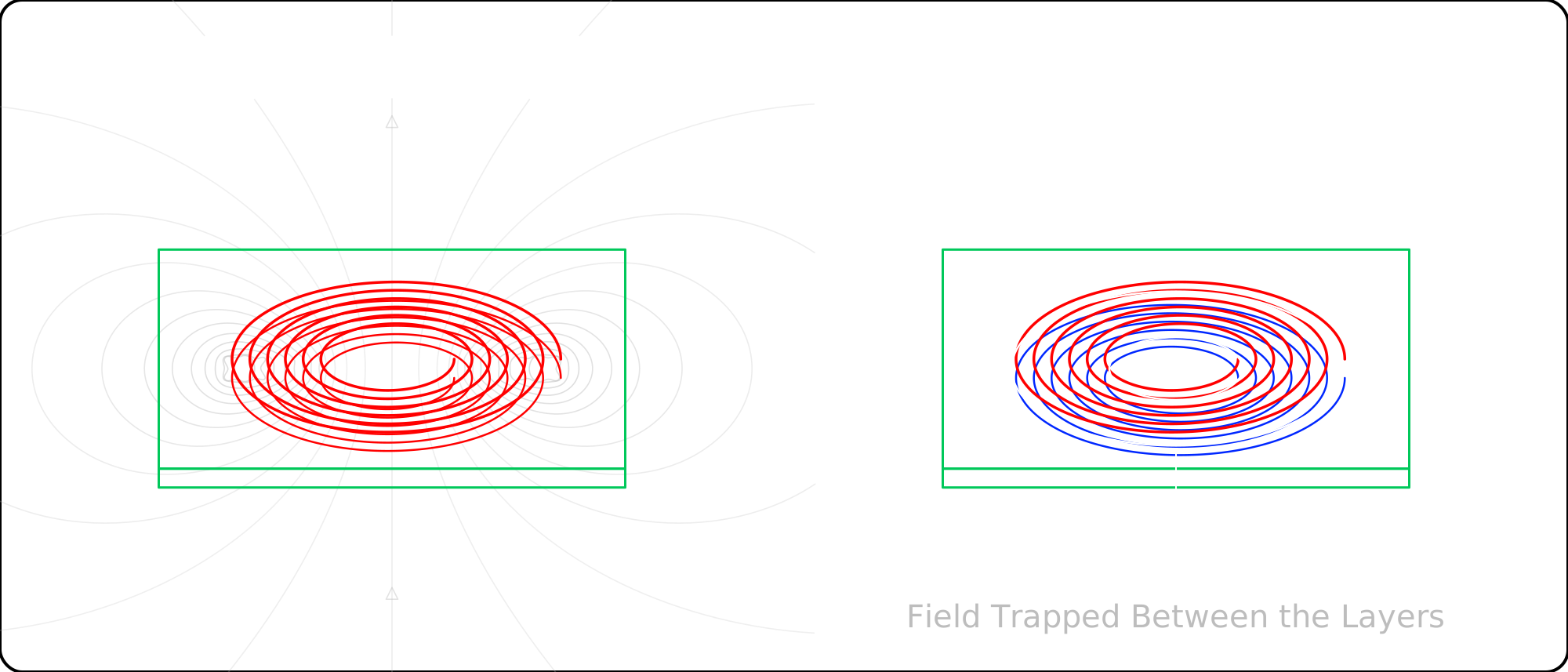
Other ways of measuring coils
Because there’s little magnetic field, it would be difficult to know you were looking at an anti-ferromagnet if you didn’t already know it was one. The reason we know is that physics already told us about them a long time ago, they’re simple to create, and we have other ways of measuring coils besides their flux when carrying current, such as their frequency response and DC impedance.[6][7] Basically, we can physically shove current in one end, see what comes out the other side, and know everything about it[d].
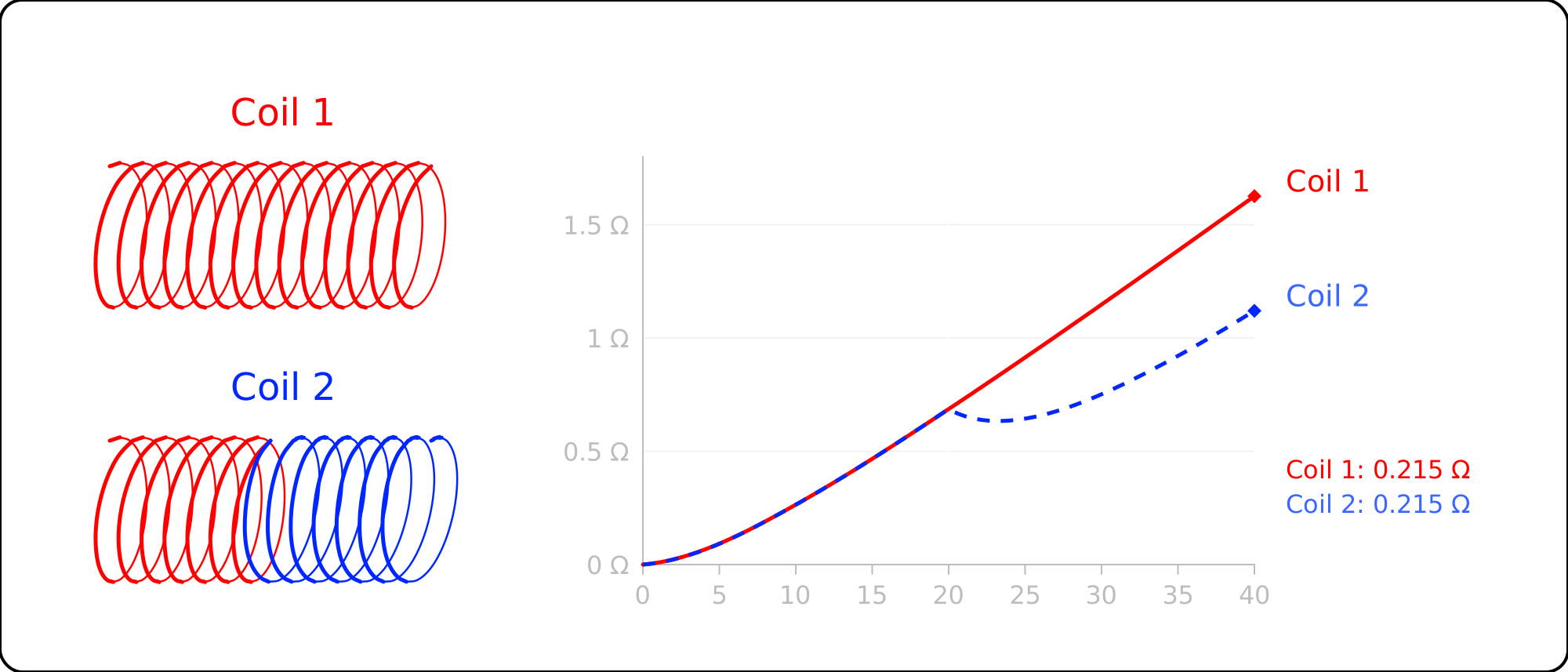
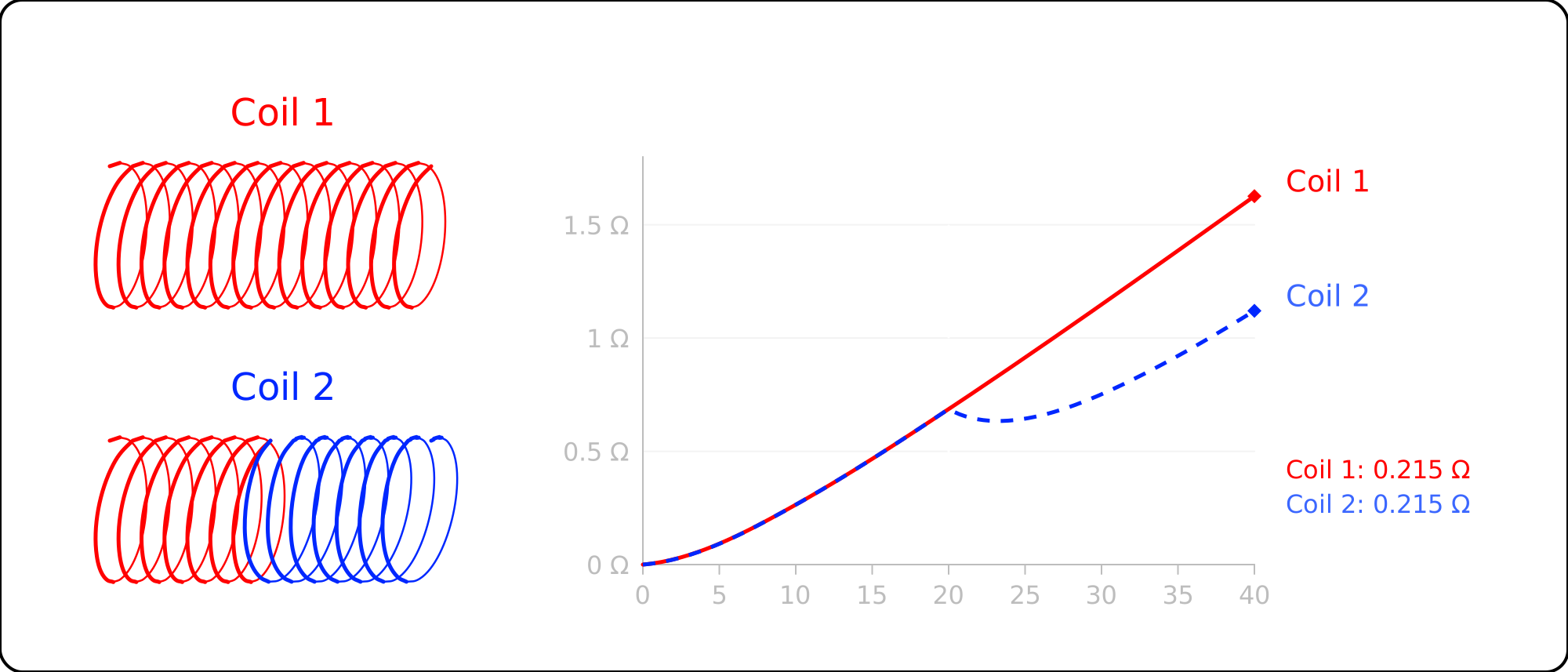
How would we even know to look?
But what if there were materials that showed no signs of being any kind of magnet, yet hidden inside their crystal structure, their spin WAS organized?
Well, the thing is, you can’t test these things very easily. If you didn’t even know that spin could be organized this way, and you didn’t have a good way to look, you might just miss altermagnets entirely. We tend to look for what we are expecting to see. I mean, if it doesn’t look or behave like a magnet or an inductive coil, and any oddities about it can be written off as system errors, how would we even know to look?
Great question. We didn't. We had no idea[e] about altermagnets until 2019,[8][9][10][11] and they weren’t confirmed in a real material until 2024.[12][13][14] Their discovery was a small and quirky thing at first. Nobody knew what they were looking at right away, and there wasn’t a framework for talking about them yet, either. The whole field has had to develop quickly as more potential altermagnets are discovered, and their importance and potential usefulness have started to become very clear, very quickly.
So, what the heck is an altermagnet?
Let’s first review a few definitions:
Electrons agree
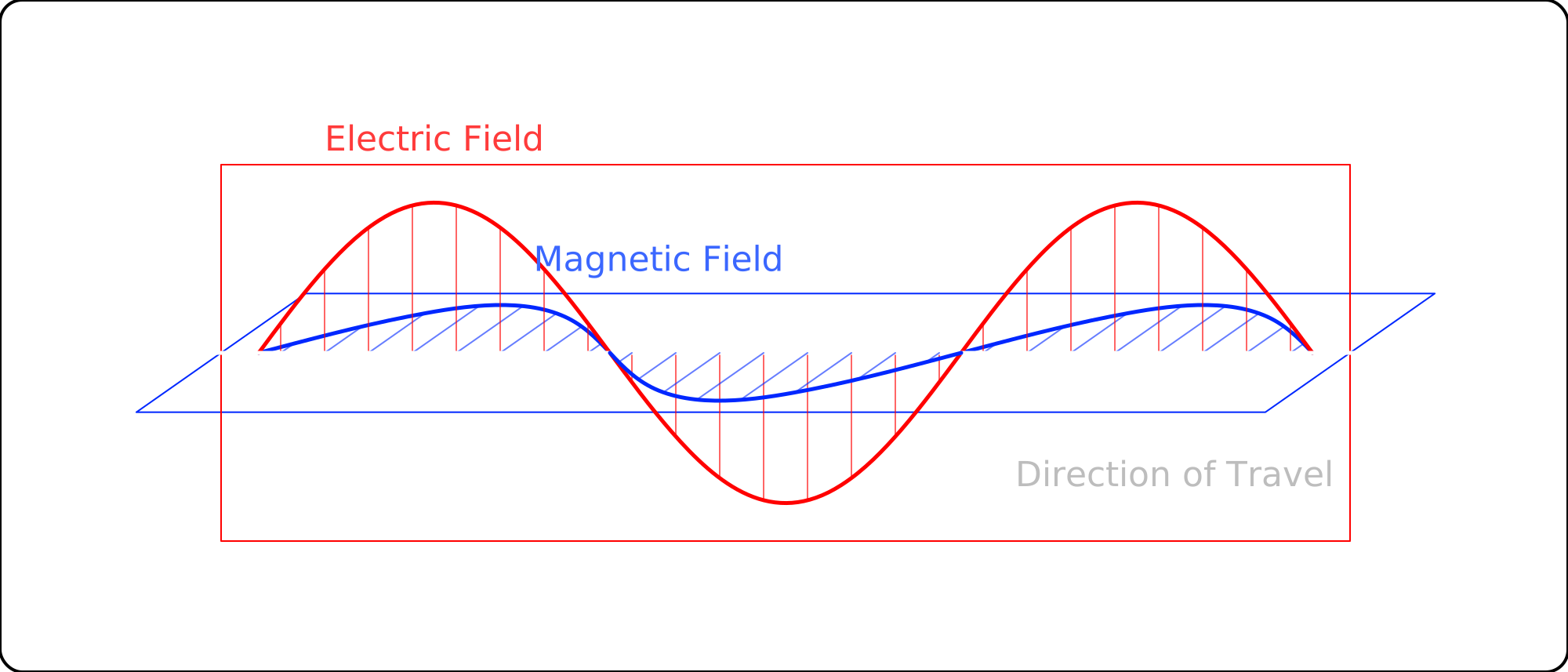
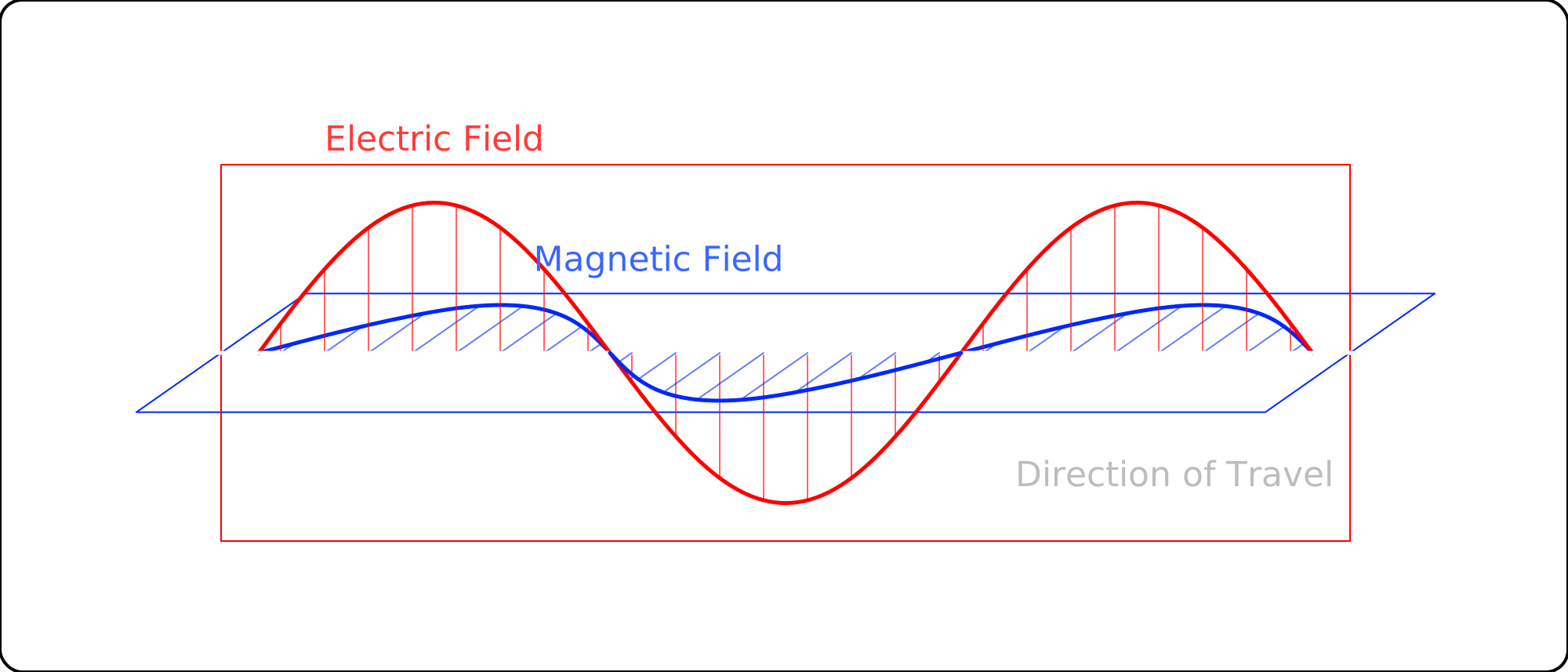
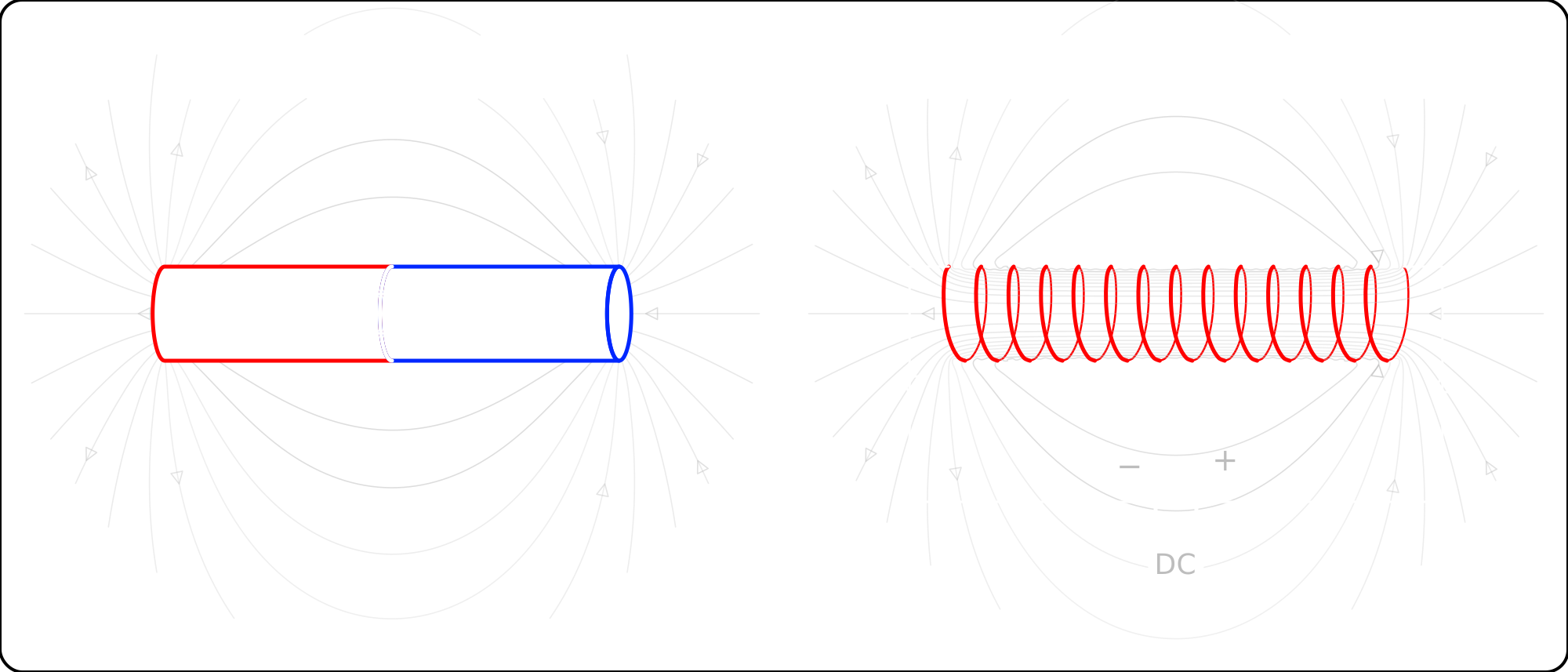
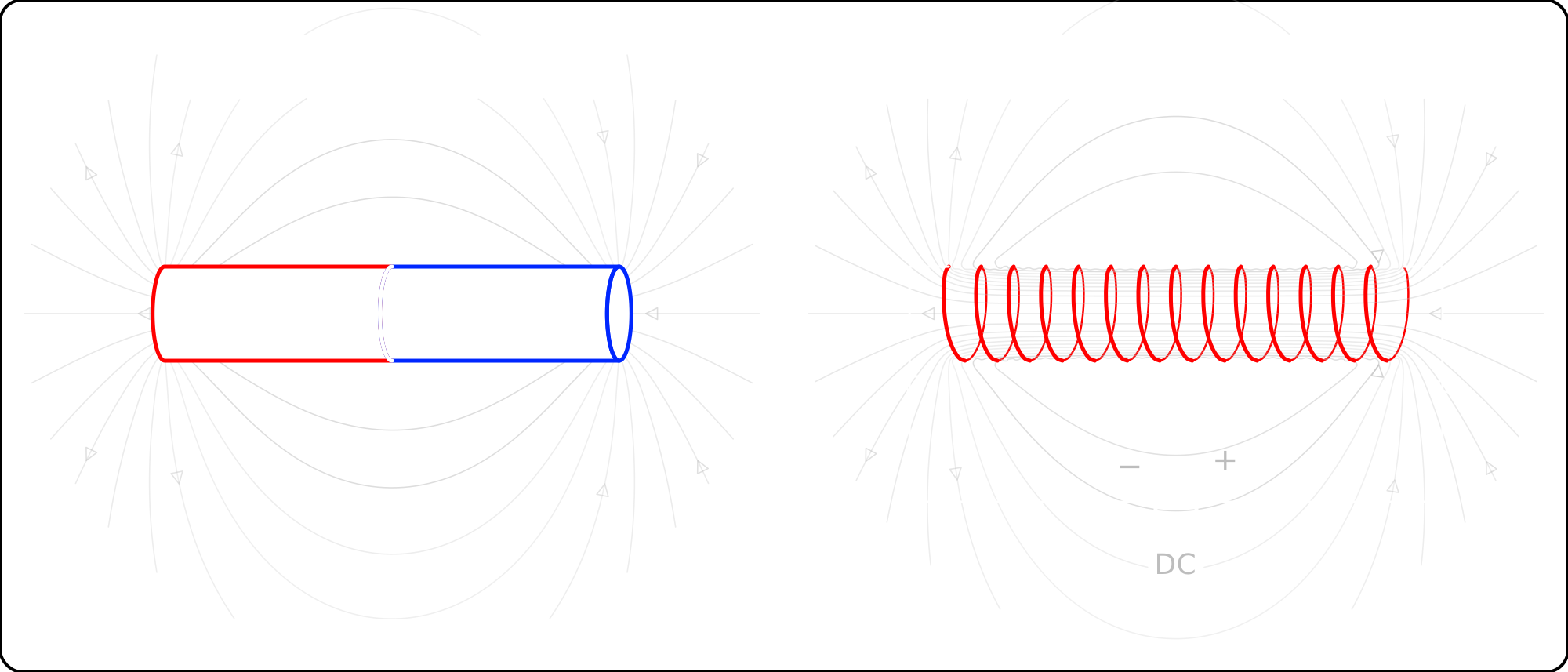
- A magnet: an object whose electrons agree on which way to spin. They either spin up or down, but since the difference between up and down in Spin theory is only a relative measurement, when they agree, it would simply be that a magnet is dominantly spin-up[f]. Because of this, it puts out magnetic flux: every electron is a tiny magnet of its own, and when they all agree[g], their fields add up.[15][16][17] A permanent magnet’s field arranges itself the same way as a coil of the same shape carrying[h] DC current.[1][2][3] The wiring in your house has magnetic flux too, because it carries current, but a periodic current, like the AC of your house, also has an Electric Field. Together with the magnetic field, that’s what radio waves are made of.[18][19] These are the 3 axes[i] of all electromagnetic things.
Which is where the next term should begin to make sense:
Equal and opposite
- An anti-ferromagnet: this would then be an object whose spins never orient into a dominant direction. At any moment or position throughout, there is no net field, and no spin orientation you can measure from the outside. In other words, its spins are organized[j], but they cancel so perfectly that it puts out no magnetic flux of its own.[21][22][23][24] Hence, it is anti-ferromagnetic, not just “non-magnetic.” The copper that carries the current powering your house is not a ferromagnet, but it is not an anti-ferromagnet either[k]. As with spin, a current in a wire has direction, so it has flux. A permanent magnet has no current[l], but its spins are all oriented the same way, so it too has flux.
An anti-ferromagnet is equal and opposite, and it’s equal and opposite the same way in every direction. No matter which way you push current through it, spin-up and spin-down electrons get through just as easily[m]. It’s a deadlock. An altermagnet is equal and opposite too. But not all things which spin the same are shaped the same...
Finally, the altermagnet
Now that we have a framework for understanding what makes something magnetic, non-magnetic, and anti-ferromagnetic, we can finally define the altermagnet.
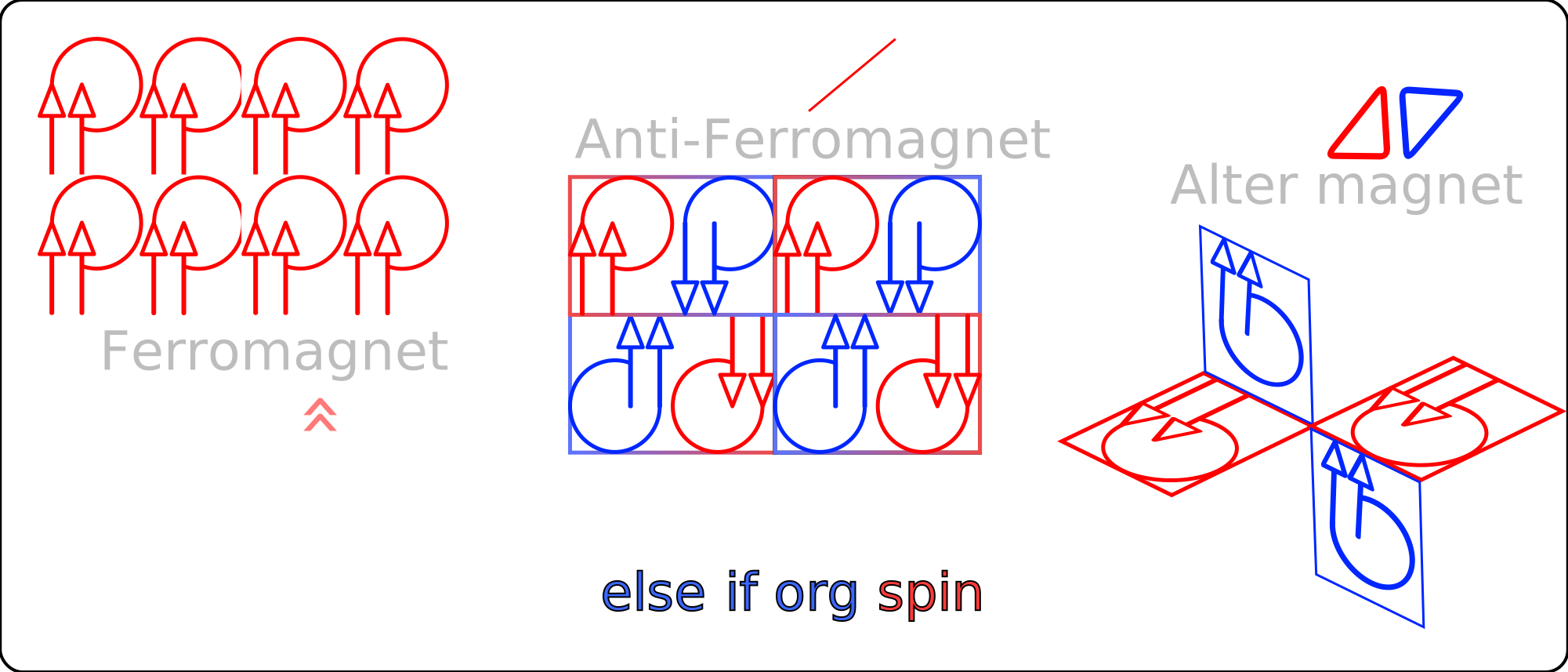
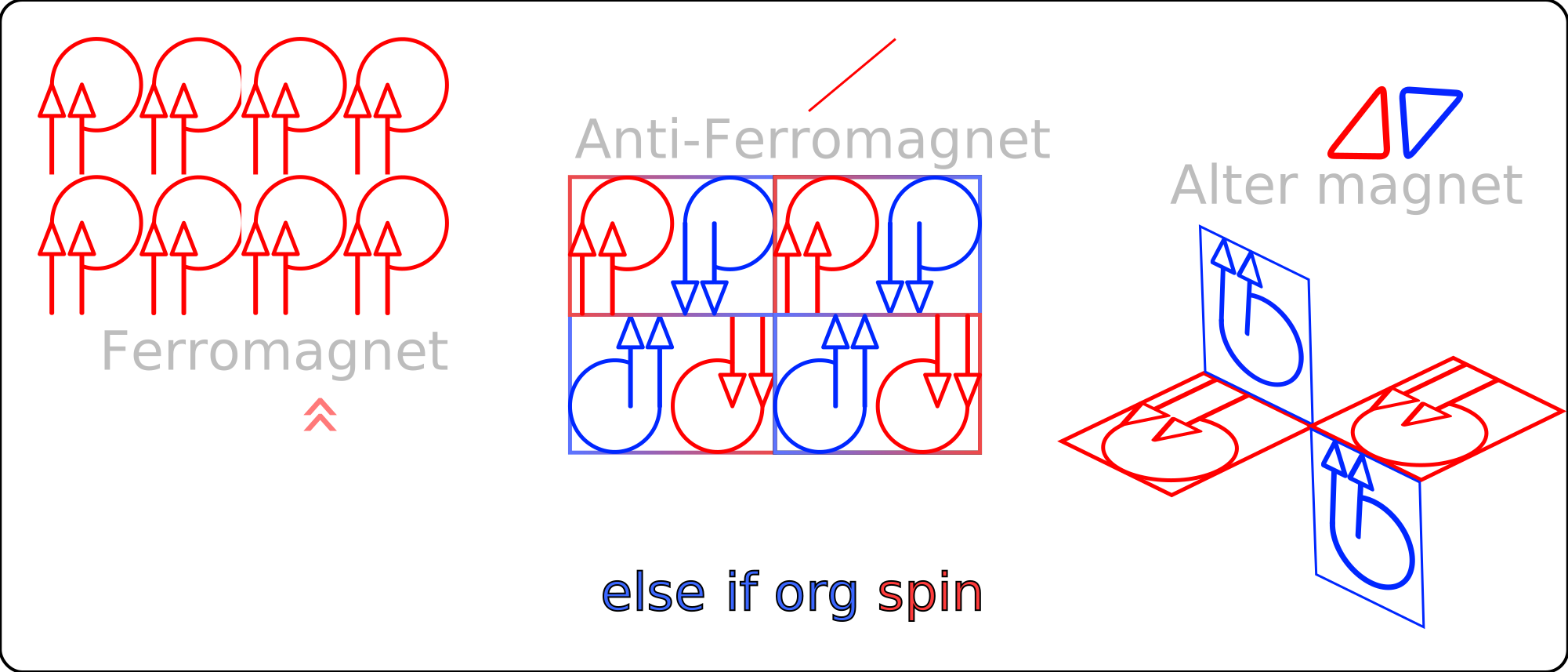
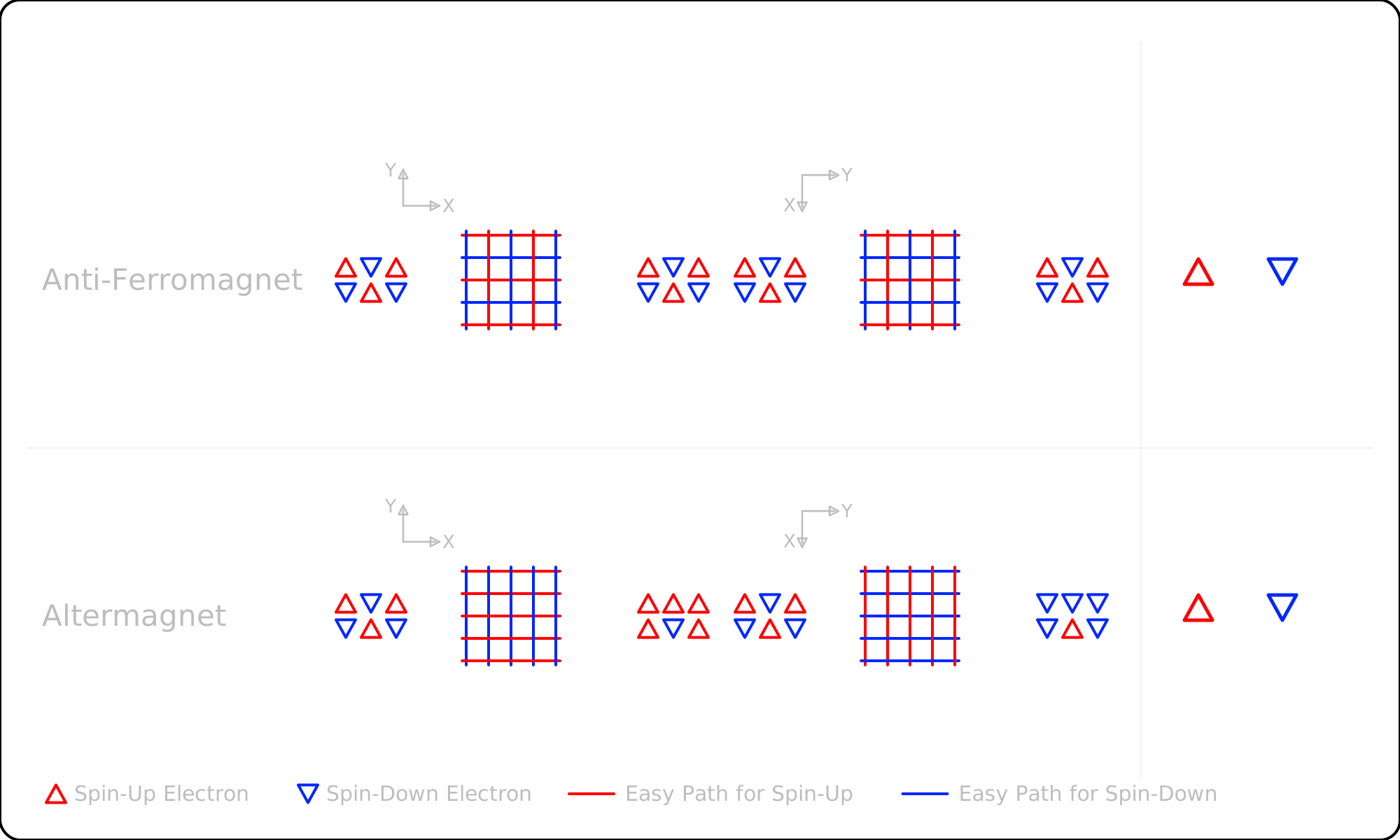
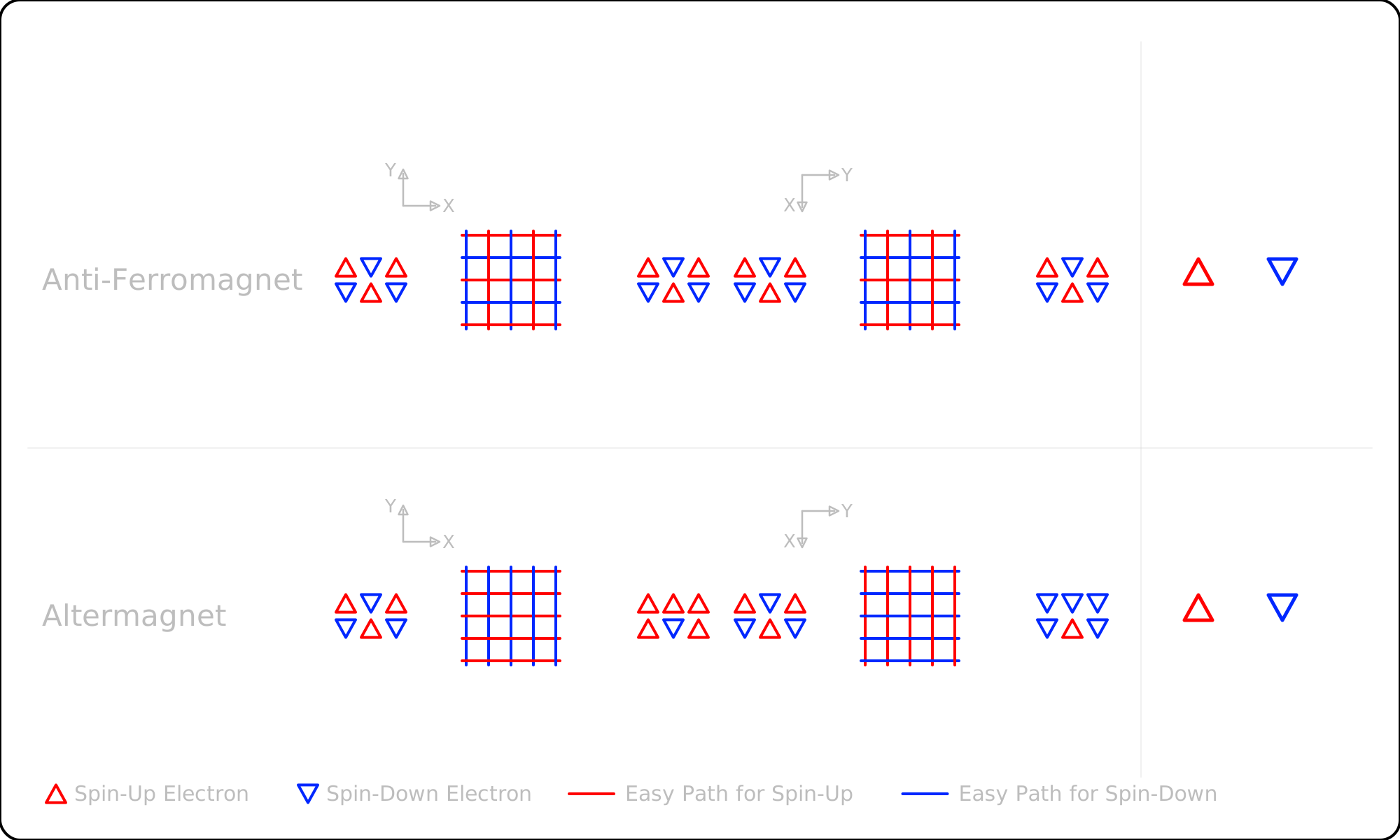
While an altermagnet might not be different when looked at from the outside, even at the smallest scale the spin-up atoms of a crystal physically must exist in their surroundings. Because of this, those surroundings can be stretched one way, and the spin-down atoms sit in surroundings stretched orthogonally[n], at 90°.[25][26][27][28] So spin-up electrons move more easily along one axis[o], and spin-down electrons move more easily along the other. It may not sound like much, but any place where there are slight differences in how something behaves gives us a place to plug numbers into the equation. With altermagnets, we now have a new kind of physical material to plug our quantum mechanics into. A function we can actually manipulate in the real world.
Possibilities in deadlock
We can push current through it along the first axis,[p] and what comes out favors spin-up. Push it along the other axis, and it favors[q] spin-down.[29][30] Add up every direction and it still balances to zero[r], so from the outside, its field looks exactly like an anti-ferromagnet’s. But pick a direction, and it’s no longer a deadlock. The possibilities are immense for materials with altermagnetic properties.
Very cool, who cares?
I’ll draw a final line between two worlds which might have been unclear until now: The world of classical/macro scale physics, and the world of micro/quantum physics.
The distinction between the current in a wire versus the spin in a permanent magnet? That’s the exact difference between the two domains of physics: the current-carrying wire lives in the macro-physics world[s], and the spin of the permanent magnet lives in the micro, quantum mechanics world. Quantum mechanics is all about things that are smaller than current in wires, specifically, things the size of subatomic particles, such as electrons and their spin. In fact, classical physics on its own predicts that permanent magnets can’t exist at all (look up the Bohr–van Leeuwen Theorem).[31] So a fridge magnet is quantum mechanics you can hold in your hand. Altermagnets could give us a physical means of directing electron spin[t] the same way a transistor gives us the means to direct current.[32][33][26]
Spin Currents are already how MRAM writes its bits; magnetic memory chips have been sold since 2006, and the spin-current kind since 2016. Each bit is a sandwich: a fixed magnetic layer, a barrier a few atoms thick, and a free magnetic layer whose direction stores the 1 or 0. A write current passing through the fixed layer comes out spin-polarized, its electrons' spins mostly lined up with that layer's magnetization. When those electrons enter the free layer, the same repulsion that keeps its spins lined up, set by the Pauli Principle, turns theirs too, within about a nanometer, to match the free layer's magnetization. Angular momentum is conserved, so the spin the electrons lose has to go somewhere, and the free layer's magnetization takes it up. That's a torque on the magnetization, the spin-transfer torque, pushing it toward the direction of the incoming spins. Above a threshold current, the torque overcomes the magnetization's natural damping and flips it. Reversing the current sends back electrons of the opposite spin, reflected off the fixed layer, and flips the bit the other way. Reading takes a smaller current: the resistance across the barrier is low when the two layers point the same way and high when they're opposed. Because the bit is written by current alone, inside the chip, with no magnetic field, the bits can be made small and packed tightly.[34][35][36][37][38][39] Altermagnets could serve as spin-current sources without the stray field of a ferromagnet,[40][41][42] and may switch at terahertz speeds, as anti-ferromagnets already do, though that is still unproven in altermagnets.[43][32][33]
Materials we've discovered already
Note: For the KEY, and, if you'd like to see the entire collection of material symbols: Library + Symbol KEY
-
Current IN
-
Current OUT: Demonstrated. Mn₅Si₃ injects a spin current whose sign flips with the order.[41] Strained CrSb produces a spin-splitting torque.[42] Current through CrSb is 62–73% spin-polarized[u], depending on the crystal face.[40]
-
Voltage OUT: Demonstrated. Anomalous Hall Effect with no net field[v], in MnTe,[44][45][46] Mn₅Si₃,[47] and CrSb.[48]
-
Spin OUT[w]: Demonstrated. CrSb order switched by current through an adjacent metal layer.[48][49] Mn₅Si₃ order switched by 180°.[50]
-
-
Voltage IN
-
Current OUT: Indirectly, through strain. MnTe on a piezoelectric substrate, order switched on and off between 310 K and 328 K[x], resistance change up to 9.7%.[51]
-
Voltage OUT: Not yet. Closest: strain from a piezoelectric cell reverses MnTe's anomalous Hall effect.[52] Proposed: gate-driven sliding ferroelectric bilayers.[53]
-
Spin OUT: Demonstrated in a close relative, the p-wave Magnet, whose spins twist a little from one atom to the next like a spiral staircase. In NiI₂, a voltage reversed the twist, at cryogenic temperatures only.[54] Not yet in an altermagnet: one indirect BiFeO₃ preprint;[55] proposed through ferroelectric switching.[56][57][58][59]
-
-
Flux IN
-
Current OUT: Demonstrated. CrSb resistance oscillations up to 68 T match the spin-split bands.[60][61] Rotating MnTe's order with a field changes its resistance.[62][63]
-
Voltage OUT: Demonstrated. A field flips the anomalous Hall voltage in Mn-doped CrSb at room temperature.[64] Field-set order also gives an anomalous Nernst voltage in CrSb and Mn₅Si₃.[65][66]
-
Spin OUT: Demonstrated. A millitesla field during cooling[y] sets the direction of MnTe's order.[67][68][69]
-
Where they could be used
| Application | Ferromagnet | Anti-ferromagnet | Altermagnet | p-wave magnet | Noncollinear anti-ferromagnet | Noncoplanar anti-ferromagnet | Incommensurate spiral |
|---|---|---|---|---|---|---|---|
| Memory density | Stray fields couple neighboring bits; caps scaling[27] | No stray field; bits pack tight[43] | No net moment, no stray field[32] | No net moment; devices only proposed[70] | Net magnetism ~1/1000 of iron's; negligible stray field[71][17] | Room-temperature memory cell sketched, not built[72] | — |
| Switching speed | Precession caps writes near GHz[43][27] | Picosecond writes shown: ~1000× ferromagnets' GHz ceiling[43] | THz dynamics expected from compensated order; unproven[32][33] | — | Current switching shown; ultrafast operation proposed[73][74] | — | — |
| Write energy | Voltage-switched through BiFeO₃: ~1/10 the energy of current writes[75] | — | Strain-switched MnTe shown; ferroelectric switching proposed[51][56][76] | Voltage switching shown in NiI₂, cryogenic only[54] | — | Voltage-gated cell proposed[72] | BiFeO₃ flips adjacent ferromagnet by voltage, room temperature[75] |
| Electrical readout | Industry-standard read; record high-resistance state 7.0× the low[38][39] | Spin-degenerate bands: no tunnel readout, only weak resistance signal[77][78] | High-resistance state predicted 2.0× the low[77] | High on/off spin valve proposed[70] | Tunnel junction of two anti-ferromagnets: high-resistance state 1.02× the low, room temperature[74] | Topological Hall signal persists to 300 K[72] | — |
| Field and radiation robustness | Outside fields can erase bits[27] | Immune to outside fields and radiation[78] | Compensated order; field-robust like anti-ferromagnets[27] | — | — | — | — |
| Spin-current sources | Spin polarizer in every MTJ[38] | Spin-degenerate bands; no non-relativistic spin current[77] | CrSb current 62–73% spin-polarized; spin torque shown[40][41][42] | Charge-to-spin conversion ~25× best spin-orbit materials, calculated[79] | — | Spin-split bands observed; device use untested[80] | — |
| Logic and transistors | Beyond-CMOS spin logic researched, not commercial[38] | — | Gate-tuned spin transistor and spin filter proposed[81][82] | Spin transistor with true zero off-state proposed[70] | — | — | — |
| RF and THz sources | Spin-torque oscillators, 1–30 GHz[38][83] | NiO oscillator calculated at 100–2000 GHz[83] | THz nano-oscillators proposed[32] | — | — | — | — |
| Thermoelectrics | Fe₃Ga films, ~6 μV/K at room temperature[84] | — | Anomalous Nernst voltage in CrSb, Mn₅Si₃[65][66] | — | Working Mn₃Sn thermopile built[71][85] | — | — |
| Inductors | Ferrite and iron cores; inductance scales with volume[7] | — | — | — | — | — | Matches a commercial inductor at ~1/1,000,000 the volume[z]; works above room temperature[86][87] |
| Neuromorphic computing | Spintronic oscillators, stochastic devices researched[38] | Multi-level cell counts thousands of pulses[78] | Electric-field-switched MnTe pitched for neuromorphic use[51] | — | Orbital-torque switching, neuromorphic use proposed[88] | — | — |
| Magnetic sensors | GMR/TMR field sensors in production[38] | — | — | — | — | — | — |
| Key | |
|---|---|
| Demonstrated | Shown in real material, or overwhelming evidence it works |
| Possible | Proposed, or shown only under limited conditions (cryogenic, disputed material) |
| Obstacle | Limited by the physics of the class itself |
| — | No reports found |
Examples: ferromagnet, Fe₃Ga. Anti-ferromagnet, CuMnAs. Altermagnet, CrSb and MnTe. p-wave magnet, NiI₂. Noncollinear anti-ferromagnet, Mn₃Sn. Noncoplanar anti-ferromagnet, Co-doped Mn₃Sn and MnTe₂. Incommensurate spiral, YMn₆Sn₆ and BiFeO₃.
Magnetic Material Data
The material links above point to my own mirror of MAGNDATA, the Bilbao Crystallographic Server's database of published magnetic structures.[89][90] I keep it open to anyone, with no sign-up required, so independent researchers can use it too.
My mirror checks for new data every 8 hours. Whenever something new is published, it updates and regenerates the full archive, so you can always download the entire up-to-date set here: magndata-latest.tar.gz
Note: my mirror isn't an exact copy. I've made a few corrections to invalid entries found upstream. See CORRECTIONS.md.
Notes
- ^
This is the case that's easiest to picture, but the result depends on geometry. For two magnets of identical material and size, magnetically biased the same way (here, disc magnets magnetized axially), what doubles is the total magnetic moment.[1] The net magnetization, how strongly each bit of material is magnetized, is set by the material, and stacking doesn't change it. Discs wider than they are tall show the effect best: stacking two changes the shape, and the field at the face rises noticeably. Once the stack is about as long as it is wide, the gain at the face drops off quickly. The material can't hold more than its remanence, the field it sustains on its own, and a face with material on only one side can only approach half of that.[4][96] Farther out, the field keeps growing with every magnet added, in step with the total moment, but it falls off with distance at the same rate no matter how many are stacked: with the cube of the distance, once you're a few magnet-lengths away.[97] Between the face and that far region the two behaviors blend. The field never reaches zero, but past a certain distance it's too small to matter.
- ^
"Weakest in the middle" holds only outside the magnet. Inside, the field is strongest at the center, where there is magnetized material on both sides.[2] Outside, the field near the middle is weak and runs along the surface. Near the ends it's strong and changes quickly over a short distance, most of all at the edges of the end faces. That change is what pulls the screwdriver. Its steel isn't magnetized until the magnet's field magnetizes it, and it magnetizes more where the field is stronger. A magnetized piece of steel in an even field gets turned to line up but isn't pulled anywhere. It's pulled only where the field is stronger on one side of it than the other, toward the stronger side.[3][98] So the pull grows with both how strong the field is and how quickly it changes across the steel, and both are greatest near the ends.
- ^
Only the overall moment cancels. The two halves sit in different places, so from any point outside, one half is slightly closer than the other and their fields don't cancel exactly. The leftover comes from the difference between two nearly equal fields, so it's weaker than either and fades faster with distance: with the fourth power of the distance instead of the cube.[5][99] Close to the coil it isn't small at all. Electrically, each half's field passes through the other half. When both halves are wound the same way, that shared flux adds to each half's inductance. When they're wound opposite, it subtracts, and with equal, tightly coupled halves the total comes out close to zero.[100] Bifilar non-inductive resistors work this way: the wire is folded back on itself before winding, so every turn sits beside one carrying current the other way.[7][101] An anti-ferromagnet does the same thing within every unit cell, a few ångströms across, so the leftover field becomes negligible within a few atomic spacings.
- ^
Pushing current in one end tells you how the coil opposes current at each frequency. At DC that's just the resistance of the wire, the DCR. As the frequency rises, the coil's own magnetic field pushes back against every change in current, and that opposition grows in step with frequency; that's its inductance.[102] Higher still, the small capacitance between neighboring turns starts carrying current around the windings, until at the self-resonant frequency the coil stops behaving like an inductor at all.[6] What the measurement gives you is an equivalent circuit, not the geometry. The counter-wound coil reads as its wire resistance plus a little leftover inductance and capacitance between windings, nearly indistinguishable from a plain resistor.[7]
- ^
The materials weren't new. MnTe and CrSb had been studied as ordinary anti-ferromagnets for decades. What the 2019–2020 papers showed, by calculation, was that in some anti-ferromagnets with all spins along one axis, electrons of opposite spin have different allowed energies at the same momentum. Splitting like that was usually attributed to spin–orbit coupling, the interaction between an electron's spin and its own motion, which is weak.[103] Here it came from the magnetic order itself, so it could be much larger. The name "altermagnet" came in 2022, along with a classification that treats rotations of the spins separately from rotations of the crystal.[25][26][104] The 2024 confirmations used photoemission: light knocks electrons out of the material, and measuring their energy and direction maps the bands directly, showing the splitting in MnTe.[12][13][14][105]
- ^
Alignment is local. A magnet's field outside itself costs energy, so a ferromagnet breaks into regions, called domains, each aligned internally but pointing different ways, letting the field close back on itself inside the material instead of leaking out. The walls between domains cost energy too, and the balance between the two sets how big the domains are.[17][113] An unmagnetized nail is a ferromagnet with its domains pointing every way. A permanent magnet is one whose crystal strongly prefers certain directions of magnetization, so once its domains are aligned they stay that way; coercivity is how strong a reverse field it takes to undo that.[114] Neodymium magnets (Nd₂Fe₁₄B) are this kind, with an unusually strong preference.[115] They're sold by grade: N52 means a maximum energy product of 52 megagauss-oersteds, roughly the most magnetic energy the material can deliver per unit volume.[116] There are also ferrimagnets, built from two interleaved sets of atoms with opposite moments of unequal size, which leaves a net moment.[117][118] Ferrites are this type. The dark grey "ceramic" magnets on fridges and in speakers and motors are hard ferrites, such as barium ferrite (BaFe₁₂O₁₉), which hold their magnetization. Ferrite beads and transformer cores are soft ferrites, nickel-zinc or manganese-zinc ferrite (NiFe₂O₄, MnFe₂O₄), which magnetize easily and let it go just as easily.[119]
- a b c d
Only unpaired electrons count. Two electrons sharing an orbital have opposite spins and cancel, so in iron, with 26 electrons per atom, the net is about 2.2 Bohr Magnetons. The electrons' own magnetic fields aren't what aligns them; that pull between neighbors is so weak it would stop holding them in line a little above absolute zero, yet iron stays magnetic up to 770 °C.[120] What aligns them is ordinary electric repulsion, reshaped by the Pauli Principle so that parallel spins cost less energy.[121] Electrons' orbits also carry moment. In iron-group metals the electric fields of neighboring atoms lock the orbits in place, so they contribute little. In rare-earth metals the responsible electrons sit deep inside the atom, shielded from their neighbors, so their orbits contribute strongly; that's part of what makes neodymium and samarium magnets so strong.[17]
- ^
This is exact for a uniformly magnetized magnet. Picture each atom's moment as a tiny current loop. Inside, each loop's current runs alongside its neighbor's going the opposite way, so they cancel. At the outer surface there's no neighbor, so a net current is left circulating around the sides.[2][126] The magnet's field is exactly the field of that sheet of current, inside and out; for a cylinder, it's an ideal solenoid.[1][127] Unlike the pole picture, this one gets the inside right too. Real magnets aren't perfectly uniform, especially near their edges, so the match is close rather than exact.
- ^
This holds for a traveling wave far from its source: the electric field, the magnetic field and the direction of travel are all at right angles to each other, and the energy flows along the third.[130] It's exact for an idealized wave in empty space with flat wavefronts, and close to true for real radio waves once you're many wavelengths from the antenna.[5][128] Close to a source, in the near field, the fields can point in any relation to each other and don't carry energy away in one direction.[2]
- a b c d
The spins do have a direction locally. An anti-ferromagnet is two interleaved sets of atoms with opposite moments, and its order is described by the Néel vector: the difference between the two sets' magnetizations, pointing along the axis the spins line up on. It does for an anti-ferromagnet what net magnetization does for a ferromagnet.[22][23] The cancellation happens over each unit cell, the smallest repeating block of the crystal, not at every point. At the atomic scale there is an alternating field, and it can be detected directly. Neutrons carry their own magnetic moment, so they scatter off the spins, and because the alternating pattern repeats over twice the distance of the atoms themselves, it produces diffraction peaks the bare crystal doesn't have.[136] That was the first direct proof of anti-ferromagnetism, in MnO.[137] Many anti-ferromagnets also tilt their spins slightly away from exact opposition, through a spin–orbit effect called the Dzyaloshinskii–Moriya interaction, and so carry a weak net moment.[138][139] Above a material's Néel temperature, thermal motion scrambles the order and it becomes paramagnetic; for MnO that happens at about 120 K.[140]
- ^
Copper is weakly diamagnetic.[141] Its electrons are paired, so there are no spins left over to order. An applied field slightly changes the motion of every electron in a way that opposes that field, which gives copper a faint push away from a magnet, about one part in 100,000 of the applied field. All materials have this response; in copper nothing stronger covers it up.[17][124] Like ferromagnetism, it has no classical explanation and is a quantum effect.[31]
- ^
No current flows through it in the ordinary sense: no charge travels around the magnet, and nothing drives one. Its field is the same as that of a current circulating around its surface, plus currents inside wherever the magnetization varies from place to place. These are called bound currents, the current the material's spins are equivalent to, fixed in place.[2][126] Their source is spin, not moving charge.
- a b
Whether spin-up and spin-down electrons conduct the same comes down to one symmetry. Electrons in a crystal can only have certain energies at a given momentum; together those allowed states make up the material's bands.[123] Flip both an electron's momentum and its spin Time Reversal, and a non-magnetic material looks exactly the same, so every spin-up state has a spin-down twin with the same energy, moving the opposite way. That's Kramers' theorem, and it's why ordinary metals carry both spins alike: a spin-down twin of every spin-up path conducts exactly as well.[142] A magnet breaks the symmetry, since reversing every moment gives a different arrangement. But in a conventional anti-ferromagnet, reversing every moment just swaps the two sets of atoms, and a shift by part of a cell, or a flip through a point, swaps them back. So the twins still exist, and both spins still conduct identically.[77] An altermagnet is the case where only a rotation or a mirror swaps them back. Each twin then sits at a rotated momentum, so the two spins match only on the planes that rotation or mirror leaves in place, and differ everywhere else.[25]
- ^
The 90° picture is the simplest case, called d-wave, as in Mn₅Si₃.[47] In momentum space, its spin splitting vanishes on two planes and changes sign each time you cross one.[25] MnTe and CrSb, the materials featured below, are g-wave: hexagonal crystals with four such Nodal Planes.[12][61] A third class, i-wave, has six. The letters are borrowed from the names of atomic orbitals, and only the even ones occur, because the splitting is the same for an electron moving one way or the opposite way.[26][104] In every class, the two sets of atoms are related by a rotation or a mirror, never by a plain shift or an inversion.
- ^
The difference lives in momentum space, the space of directions and speeds an electron can travel with, rather than in positions inside the crystal. In a metal, the electrons that carry current sit on a surface in that space called the Fermi surface, the boundary between filled and empty states.[145] In an altermagnet, the spin-up and spin-down Fermi surfaces have the same shape, rotated against each other.[26] Along the direction where one is stretched, its electrons move faster and respond more easily to a push, behaving as if they were lighter (their effective mass), and the other spin does the opposite.[146] The splitting comes from the same repulsion that lines up the magnetic spins, set by the Pauli Principle, not from the much weaker spin–orbit coupling, so it can be large: hundreds of millielectronvolts in MnTe, many times the thermal energy at room temperature.[12][14]
- a b
A crystal's axes are fixed directions in its lattice, and in a single crystal they run the same way through the whole piece, so they can be found and marked, for instance by X-ray diffraction.[147] Current flows between the contacts you attach, so choosing which faces to put contacts on, or which way to pattern a strip of thin film grown on a crystal of known orientation, chooses the crystal direction the current travels along. Thin-film devices are often patterned as several strips at different angles on one chip, so the directions can be compared side by side.[42] Two things blur the effect in an ordinary piece of material. A polycrystal is many small grains pointing every which way, so their directions average out. And the magnetic order forms domains, regions where the arrangement is reversed and the favored spin along each axis flips with it, so the sample has to be set into a single domain for the effect to survive, for example by cooling it through its ordering temperature in a small field.[67] CrSb and Mn₅Si₃ are metals and MnTe is a semiconductor, so current can be pushed through them directly.[41] Not every altermagnet allows that; many candidates, like MnF₂, are insulators and are studied with light, X-rays or neutrons instead.[26]
- ^
This is the simplest case, a d-wave altermagnet.[104] Push current along either of its two main axes[p] and it comes out spin-polarized, with opposite signs for the two axes. Push it along a diagonal, where the two spins conduct equally, and the current carries no net spin along its path, but a pure spin current splits off sideways, at right angles: the spin-splitter effect.[29][30] g-wave altermagnets like CrSb can't do this on their own. Their pattern can be pictured as three d-wave patterns rotated 120° from each other, and the three spin currents cancel exactly. Squeeze the crystal slightly out of shape and that rotation is broken, the cancellation fails, and the effect appears. Calculations predict up to 5% conversion under 1% strain, and strained CrSb has shown it.[148][42]
- a b
The zero isn't two moments that happen to balance, as in a compensated ferrimagnet; the crystal's symmetry forces it to be exactly zero.[25] The electrons still break Time Reversal symmetry, though, and that's what an Anomalous Hall Effect requires, so an altermagnet can produce one with no net moment at all.[10] Once spin–orbit coupling is included, a small net moment is also allowed, and MnTe films do show one.[45]
- ^
The wire is quantum underneath too; whether a material conducts at all is decided by its Bands.[124] But in copper every spin-up state has a spin-down twin[m] at the same energy. If that sounds familiar, it should: an anti-ferromagnet's electrons are paired the same way. The difference is in Real Space. Two electrons sharing a state must have opposite spins, so a filled pair cancels.[125] An atom has a moment only if it has unpaired electrons that stay on the atom, which in practice means a partly filled inner
dorfshell, whose orbitals sit close to the nucleus; there, the unpaired spins align[g] and the atom carries a fixed moment.[17] Copper's unpaired electron is in its outer shell, and in the metal it spreads across the whole crystal, where states fill two at a time, one spin-up and one spin-down, so it pairs off and no atom keeps a moment.[124][17] So copper gets the twins by having no magnetic order, and an anti-ferromagnet gets them despite having one, because its symmetry pairs the two sublattices back up.[25] Either way, the two spins conduct identically and spin drops out of the current entirely. What's left is charge moving on average, which classical electrodynamics describes accurately through averages like current density and conductivity.[124] In an altermagnet those twins are split, spin-up and spin-down travel differently, and spin can't be averaged away.[26] - ^
A spin current only survives a short distance. Its electrons keep their charge the whole way, but the lean they share, most of their spins pointing one way, gets scrambled as they travel: each collision with an impurity or a vibrating atom has a small chance to flip a spin, through spin–orbit coupling, so the lean fades over a set distance, the spin diffusion length.[154] In copper at room temperature, that's about 350 nanometers.[155] So spin devices have to be small, or turn the spin back into an ordinary charge signal before it fades. The first proposed spin transistor depends on exactly this: its spins have to cross a semiconductor channel and arrive still pointing the right way.[156][154]
- ^
The 62–73% comes from point-contact Andreev reflection, a way to count how lopsided a material's spins are by touching it with a superconducting tip.[40] In a superconductor, electrons travel in pairs of opposite spin, so an electron crossing in from the sample needs a partner of the opposite spin to go with it. The fewer opposite-spin electrons the sample has, the more often that crossing fails, and the current at the contact reveals the share of each spin.[159][160] The number describes the electrons at that one small contact, not current flowing through a whole sample, and since an altermagnet's spin splitting depends on direction, it depends on which crystal face the tip touches.
- ^
Whether an altermagnet shows this effect depends on which way its order points. MnTe's alternating spins lie flat within its layers, a direction that allows the effect; CrSb's point straight through the layers, a direction its symmetry forbids it in.[64] So the CrSb results first change the crystal's symmetry, by growing films whose structure tilts the order or by mixing in manganese to turn it, and only then does the voltage appear.[48][64]
- ^
"Spin out" is half a joke: nothing spins out of the device, and no spin current comes out either. The output is the material's magnetic order itself: the device sets or flips which way its alternating spins point, its Néel vector[j]. Because these materials' moments cancel, that change sends out no field a coil or compass could pick up, so it's read back in other ways: as a change in resistance, as an anomalous Hall voltage that flips sign with the order, or by imaging with X-rays or neutrons.[10][67][137]
- ^
Those two temperatures are MnTe's Néel temperature[j], the point above which its spins lose their alternating order, without and with the voltage. In this sample the order disappears at about 310 K. The voltage strains a piezoelectric layer underneath, which squeezes the MnTe and raises that point to 328 K, so between the two temperatures the voltage switches the order on and off, and the resistance changes by up to 9.7% with it.[51]
- ^
Field-cooling means cooling the material from above the temperature where its order forms, its Néel temperature[j], down into the range below it where the order exists, while a magnetic field is applied. An altermagnet's order can form in either of two opposite versions, related by Time Reversal, and the field tips the choice as the order forms: MnTe carries a tiny net moment[r] alongside its order, and the field favors the version whose moment points along it. Once the material is cold, the order is locked in and the field can be removed. Patterning the film into small shapes before cooling lets the same trick set single domains, down to individual vortices.[67]
- ^
An emergent inductor is an inductor with no coil, made from a magnet whose spins form a spiral. Current pushes the spiral along, and the moving spiral pushes back on the electrons with a voltage of its own, which acts like an inductor's.[86] It can match an ordinary inductor's inductance at about a millionth of the size, but not its behavior. In the first device, made from Gd₃Ru₄Al₁₂, the inductance was negative, the opposite sign of a coil's, it changed with the current and the frequency, and the spiral only forms below about 20 K.[86] A later device in YMn₆Sn₆ worked above room temperature, but its inductance flipped sign depending on temperature, field and current.[87]
Terms
- ^Poles
Strictly, magnets have no poles. Before spin was understood, every model of a permanent magnet needed a hidden source: magnetic charge sitting at the ends (Gilbert, Coulomb), or Ampère's "molecular currents" circulating forever inside the material with no resistance.[91][92][93] Neither exists as described; classical physics can't sustain either one, and the real source is electron spin.[31] Outside the magnet, both pictures draw the same field lines, and "north" and "south" are reasonable names for the faces where flux leaves and enters, an intuitive fit for a current loop. What doesn't hold up is the idea of field radiating from those faces, because a magnetic field has no sources or sinks. To check a point for one, wrap a tiny closed surface around it, take the net flux coming out through that surface, and divide by the volume it encloses. As the surface shrinks down to the point, that ratio is the divergence: flux out per unit volume.[94] For a magnetic field it is zero everywhere, so at every point as much flux flows in as flows out.[2][95] Field lines therefore have no ends. Each one closes on itself, running through the magnet from the south face to the north face and returning around the outside. Poles stay in use because they're convenient: treat each end face as carrying a fictitious magnetic charge, set by how much magnetization points out through it, and the field outside comes out right. Inside, it comes out wrong, which is how you know the charges aren't real; none has ever been isolated.[5] As a visual, poles work for both pictures, but the physics underneath is more than a picture can carry.
- ^Spin
Electrons don't physically rotate. Treated as a spinning ball of charge, an electron's surface would have to move faster than light to produce its measured moment.[15][106] Spin is angular momentum the electron simply has, with a fixed magnetic moment of about one Bohr magneton, the natural unit for atomic magnetism.[107][108] Measured along any axis, it only ever comes out one of two values, up or down.[109] It doesn't turn like an object in space either: rotating an electron's spin state through 360° flips the sign of its quantum state, and it takes 720° to bring it back. That holds for every spin-½ particle, and it has been measured directly with neutrons.[110][111][112] The axis itself is arbitrary; in a magnet the order picks it, which is why "up" just means "along the majority."[17]
- ^Electric Field
Any conductor at a voltage has an electric field around it, DC included.[2] What AC adds is change over time. A changing magnetic field produces an electric field, and a changing electric field produces a magnetic field, so once both are changing they can keep regenerating each other and travel away from the wire on their own. That's radiation.[18][19][128] How well a conductor radiates depends on its size compared to the wavelength. At 60 Hz the wavelength is about 5000 km, so house wiring is an extremely poor antenna. Its fields mostly stay put, rising and falling with the current and handing their energy back each cycle; these are called near fields.[129]
- ^60 Hz Hum
The grid runs at 60 Hz in North America and 50 Hz in most of the world.[131] Hum also contains multiples of that frequency. Power supplies that convert AC to DC draw current in pulses twice per cycle, which puts a buzz at 120 Hz, and transformers and other nonlinear loads distort the waveform further.[132] In audio gear, hum gets in through three main paths, almost none of it radiated.[7] A ground loop forms when two pieces of equipment are connected to ground by two paths at once, typically the mains safety earth and a cable shield. The two paths run in parallel between the same two chassis, so together they close a loop of their own, separate from the signal's loop. Current circulates around it, driven by a small difference in ground potential between the two outlets or by AC magnetic flux passing through the area the loop encloses. Where that current flows through the shield, the shield's resistance turns it into a voltage that shifts one end's ground relative to the other's. The moment the loop closes, that shift becomes common-mode and lifts both signal conductors equally. To sink is to source, so the hum is now in your loop.[133] A balanced input reduces it but never removes it, a fundamental result of Coupling, and any imbalance in impedance, even a single resistor, lets more through. On an unbalanced line, the shield is the signal return itself, so the drop lands directly in series with the signal. In magnetic pickup, any loop formed by signal wiring acts as a one-turn transformer winding for nearby AC magnetic fields.[20] In capacitive pickup, the electric field of nearby power wiring couples through tiny stray capacitance into high-impedance inputs.[7]
- ^Bohr–van Leeuwen Theorem
The Bohr–van Leeuwen theorem is the proof that classical physics alone can't make any material magnetic.[31][152] A magnetic field only pushes moving charges sideways, so it never changes their energy, and in a material at a steady temperature that leaves their motion, on average, exactly as it was: the net magnetization always comes out zero.[153][2] Every magnet depends on two things classical physics leaves out: spin, and the Pauli Principle. Because no two electrons can share a state, pairs of electrons with matching spins repel[g]. Think of it like trying to force magnets together the wrong way: they repel more the closer together they are. So matching spins stay farther apart. When electrons can't move away from each other any other way, pointing the same way is how they keep their distance, so neighboring spins line up. Think of it like avoiding your neighbor by always leaving 20 minutes before they do. In a way, you are in sync with them, yet you manage to keep a safe distance and avoid having to talk with them, as long as you keep it up. The distance is created by being on the same cycle and 20 minutes ahead. The moment they leave 20 minutes early, you're pointing at them instead of the same direction as them, despite your same buffer. The distance changed because your cycles were pointing at each other again. The exact same thing happens if you wake up 20 minutes later. But if you wait another 20 minutes, you might be 40 minutes late to work, but you'll avoid your neighbor.
- ^Spin Currents
A spin current carries spin rather than, or as well as, charge: spin-up electrons drifting one way and spin-down the other, or an ordinary current in which one spin outnumbers the other. A spin-current source turns an ordinary charge current into one. Ferromagnets do it by filtering current through their own magnetization, but they bring their stray field with them.[38] Heavy metals like platinum and tantalum do it through the spin Hall effect, which relies on spin–orbit coupling and converts only a modest share of the current.[157][158] Altermagnets split spin through that same repulsion, set by the Pauli Principle, carry no stray field, and their crystal axes set which spin goes which way.[26]
- a b c d ePauli Principle
The Pauli principle is the rule that no two electrons can share the same state, which is why each state holds at most two, one spin-up and one spin-down.[125] It also changes how hard electrons push on each other. Two electrons with matching spins can't share a state, so they're forced to stay farther apart than a mismatched pair, and since electrons push on each other harder the closer they are, the matching pair pushes less. In some materials that makes parallel spins the lower-energy arrangement, and the spins line up to take it.[16][17]
- a bAnomalous Hall Effect
Push current through a conductor in a magnetic field and the field pushes the moving charge sideways, building a voltage across the conductor at right angles to the current. That's the Hall effect, found by Edwin Hall in 1879.[149] Soon after, he found the same sideways voltage about ten times larger in iron, and magnetic conductors show it even with no field applied, driven by their own magnetism instead. That's the anomalous Hall effect.[150] It takes two things: the material has to break time reversal symmetry, and its electrons have to feel spin–orbit coupling, which ties their spin to their direction of motion.[10]
- ^p-wave Magnet
A p-wave magnet is a close relative of an altermagnet whose spin splitting is lopsided rather than balanced. In an altermagnet, a spin-up electron moving one way behaves exactly like a spin-up electron moving the opposite way. In a p-wave magnet that flips: a spin-up electron moving one way matches a spin-down electron moving the other way, so unlike an altermagnet, the material keeps Time Reversal symmetry.[161] It takes a spiral like this one, with all the spins in one plane, that also lines up with the crystal, repeating after an even number of the crystal's repeating units, so that shifting by part of a repeat looks the same as flipping every spin.[161][162] Spirals that never line up with the crystal are a separate class, the table's last column. NiI₂ can be switched with a voltage because its spiral is tied to the crystal's built-in electric polarization, so reversing the polarization reverses the spiral.[54] Spin is best understood through symmetry, at two levels. Spin itself comes from the symmetry of space. Quantum mechanics classifies particles by how they behave under rotation, and spin is the label for that behavior, which is why a spin-½ particle needs 720° to come back to itself.[163][164] That much belongs to every electron on its own. What a magnet's spins do is another matter. "Up" and "down," which atoms belong to which set, and whether a material is a ferromagnet, an anti-ferromagnet or an altermagnet are not properties of any single spin. They are defined only by the complete arrangement of moments relative to each other and to the lattice they sit in, and that arrangement is only possible within the geometry of that structure.[25] The notation for a magnetic order resolves only as a consequence of everything else at once, and it only means anything where moments sit close enough to couple to each other.[107]
- ^Bohr Magnetons
The Bohr magneton is the natural unit of magnetic moment at the atomic scale. An electron with the smallest nonzero orbital angular momentum quantum mechanics allows produces a moment of exactly one Bohr magneton, the same as a classical loop of current made by an electron orbiting with that angular momentum. Its size, about 9.274 × 10⁻²⁴ joules per tesla, is set entirely by the electron's charge, the electron's mass, and that smallest unit of angular momentum.[122][108] An electron's spin carries almost exactly the same moment, 1.00116 Bohr magnetons. Iron's figure isn't a whole number because in a metal the outer electrons aren't tied to single atoms; they're shared across the crystal in Bands, so the count of unpaired electrons per atom comes out fractional.[17]
- ^Bands
A band is where spin pairs live: a crystal's shared electrons. Every state in a band holds two electrons, one spin-up and one spin-down. Thus, when an atom's electrons can't pair off in a band, because they can't move between the atoms around them, the opportunity for a magnetic moment is born: each atom keeps its leftover spin, and those spins interact with their neighbors'[g]. An electron held by a single atom can only have a few particular energies, like rungs on a ladder. In a crystal, the outer electrons are shared by the whole crystal instead, and each rung spreads into a wide range of closely spaced energies: a band.[123] Electrons fill the bands from the lowest energy up, two to a state. If the top band is only partly full, electrons have empty states just above them to move into, so they can carry current: a metal. If it's completely full, an electron can only move by jumping all the way up to the next band: an insulator, or a semiconductor when that jump is small. Inner electrons stay close to their own atoms, so their rungs barely spread, which is why they can stay on their atoms.[124]
- ^Coupling
Around any closed loop, the two conductors are traversed in opposite directions, so anything that appears equally on both is equal and opposite around the loop and cancels on its own.[134] With no nonlinear junctions inside the loop – a purely resistive load – that cancellation would in theory be exact. In reality it never quite is. The same loop current that lifts both conductors also couples into each of them, through its magnetic field and through stray capacitance, and the two conductors run alongside each other but never in exactly the same place, so each couples a little differently, through no fault of yours or the circuit's.[135] The same applies to any outside noise source near the cable.[7] Whatever ends up different between the two sides is no longer common mode, and nothing downstream can tell it apart from signal. In other words, all difference between channels is signal, no matter where it comes from.
- ^Time Reversal
Time reversal asks what a system looks like run backward, like a film played in reverse.[143] Positions stay put, but everything that describes motion flips: velocities, momenta and currents all point the other way. Magnetic fields and moments flip too. A field produced by a current reverses when the current does, and spin, being angular momentum, reverses like any other rotation.[144] The laws governing electrons in a crystal are unchanged by it, so whatever they allow running forward, they allow running backward. A material can still break it, though: a magnet's fixed pattern of moments, reversed, is a different pattern.
- ^Nodal Planes
These planes are in momentum space, the three-dimensional space of directions and speeds an electron can travel with. A plane there is a whole fan of travel directions, and an electron moving in any direction within it sees no spin splitting. The planes never sit side by side or stack. Because the splitting is the same for an electron moving one way or the opposite way, every plane passes through the center, and they all cross there, cutting momentum space into wedges like slices through an orange. The splitting flips sign from each wedge to the next.[25][26] In a d-wave altermagnet, two planes meet at right angles and make four wedges, alternating spin-up, spin-down, up, down: the cloverleaf of a
dorbital. In CrSb, mapped directly in the bulk, one plane lies flat through the middle and three more stand vertically through it, 60° apart, so the splitting takes the shape of agorbital of the hydrogen atom. The vertical planes cut six wedges around the vertical axis, alternating in sign, and the flat plane splits each wedge into a top and a bottom of opposite sign, making twelve regions in all.[61] MnTe shares CrSb's crystal structure and is g-wave too.[12] i-wave altermagnets have six planes and finer patterns still.[104] - ^Real Space
Real space is the physical space the crystal occupies, the space you could measure with a ruler: where each atom sits, and which way each atom's moment points. Walk through an anti-ferromagnet atom by atom and you'd find up, down, up, down; walk through copper and you'd find no moments pointing either way.[124] Momentum space isn't a place at all. Each point in it stands for one way an electron can move, a direction and a speed, so it describes motion rather than location. The spin twins belong there: for every way a spin-up electron can move, a spin-down electron can move the same way with the same energy.[151]
References
- a b c d
N. Derby, S. Olbert, "Cylindrical magnets and ideal solenoids", Am. J. Phys. 78, 229–235 (2010); open-access preprint: arXiv:0909.3880. https://arxiv.org/abs/0909.3880
- a b c d e f g h i j k
D. J. Griffiths, Introduction to Electrodynamics, 5th ed., Cambridge University Press, Ch. 6 (2023). https://doi.org/10.1017/9781009397735
- a b c
E. M. Purcell, D. J. Morin, Electricity and Magnetism, 3rd ed., Cambridge University Press, Ch. 11 (2013). https://doi.org/10.1017/CBO9781139012973
- a b
J. M. Camacho, V. Sosa, "Alternative method to calculate the magnetic field of permanent magnets with azimuthal symmetry", Revista Mexicana de Física E 59, 8–17 (2013). https://rmf.smf.mx/ojs/index.php/rmf-e/article/view/4692
- a b c d
J. D. Jackson, Classical Electrodynamics, 3rd ed., Wiley, Ch. 4–5 (1999).
- a b
Keysight Technologies, Impedance Measurement Handbook, 6th ed. (2020). https://www.keysight.com/us/en/assets/7018-06840/application-notes/5952-1087.pdf
- a b c d e f g h
H. W. Ott, Electromagnetic Compatibility Engineering, Wiley (2009).
- ^
S. Hayami, Y. Yanagi, H. Kusunose, "Momentum-Dependent Spin Splitting by Collinear Antiferromagnetic Ordering", J. Phys. Soc. Jpn. 88, 123702 (2019); open-access preprint: arXiv:1908.08680. https://arxiv.org/abs/1908.08680
- ^
K.-H. Ahn, A. Hariki, K.-W. Lee, J. Kuneš, "Antiferromagnetism in RuO₂ as d-wave Pomeranchuk instability", Phys. Rev. B 99, 184432 (2019); open-access preprint: arXiv:1902.04436. https://arxiv.org/abs/1902.04436
- a b c d
L. Šmejkal, R. González-Hernández, T. Jungwirth, J. Sinova, "Crystal time-reversal symmetry breaking and spontaneous Hall effect in collinear antiferromagnets", Sci. Adv. 6, eaaz8809 (2020). https://pmc.ncbi.nlm.nih.gov/articles/PMC7274798/
- ^
L.-D. Yuan, Z. Wang, J.-W. Luo, E. I. Rashba, A. Zunger, "Giant momentum-dependent spin splitting in centrosymmetric low-Z antiferromagnets", Phys. Rev. B 102, 014422 (2020); open-access preprint: arXiv:1912.12689. https://arxiv.org/abs/1912.12689
- a b c d e
J. Krempaský et al., "Altermagnetic lifting of Kramers spin degeneracy", Nature 626, 517–522 (2024). https://pmc.ncbi.nlm.nih.gov/articles/PMC10866710/
- a b
S. Lee et al., "Broken Kramers Degeneracy in Altermagnetic MnTe", Phys. Rev. Lett. 132, 036702 (2024); open-access preprint: arXiv:2308.11180. https://arxiv.org/abs/2308.11180
- a b c
T. Osumi et al., "Observation of a giant band splitting in altermagnetic MnTe", Phys. Rev. B 109, 115102 (2024). https://doi.org/10.1103/PhysRevB.109.115102
- a b
G. E. Uhlenbeck, S. Goudsmit, "Spinning Electrons and the Structure of Spectra", Nature 117, 264–265 (1926). https://doi.org/10.1038/117264a0
- a b
W. Heisenberg, "Zur Theorie des Ferromagnetismus", Z. Phys. 49, 619–636 (1928). https://doi.org/10.1007/BF01328601
- a b c d e f g h i j
S. Blundell, Magnetism in Condensed Matter, Oxford University Press (2001). https://doi.org/10.1093/oso/9780198505921.001.0001
- a b
J. C. Maxwell, "A Dynamical Theory of the Electromagnetic Field", Phil. Trans. R. Soc. Lond. 155, 459–512 (1865). https://doi.org/10.1098/rstl.1865.0008
- a b
H. Hertz, "Ueber Strahlen electrischer Kraft", Annalen der Physik 272, 769–783 (1889); open-access copy: https://zenodo.org/record/2168811
- a b
J. Swanson, W. T. Kaune, "Comparison of residential power-frequency magnetic fields away from appliances in different countries", Bioelectromagnetics 20, 244–254 (1999). https://doi.org/10.1002/(SICI)1521-186X(1999)20:4<244::AID-BEM5>3.0.CO;2-2
- ^
L. Néel, "Influence des fluctuations du champ moléculaire sur les propriétés magnétiques des corps", Ann. Phys. 10(18), 5–105 (1932); open-access copy: https://hal.science/hal-02888373
- a b
L. Néel, "Magnetism and Local Molecular Field" (Nobel lecture), Science 174, 985–992 (1971); open-access copy: https://hal.science/hal-02888378
- a b
V. Baltz et al., "Antiferromagnetic spintronics", Rev. Mod. Phys. 90, 015005 (2018). https://doi.org/10.1103/RevModPhys.90.015005
- ^
T. Jungwirth, X. Marti, P. Wadley, J. Wunderlich, "Antiferromagnetic spintronics", Nat. Nanotechnol. 11, 231–241 (2016); open-access preprint: arXiv:1509.05296. https://arxiv.org/abs/1509.05296
- a b c d e f g h
L. Šmejkal, J. Sinova, T. Jungwirth, "Beyond Conventional Ferromagnetism and Antiferromagnetism: A Phase with Nonrelativistic Spin and Crystal Rotation Symmetry", Phys. Rev. X 12, 031042 (2022). https://doi.org/10.1103/PhysRevX.12.031042
- a b c d e f g h i
L. Šmejkal, J. Sinova, T. Jungwirth, "Emerging Research Landscape of Altermagnetism", Phys. Rev. X 12, 040501 (2022). https://doi.org/10.1103/PhysRevX.12.040501
- a b c d e
L. Bai et al., "Altermagnetism: Exploring New Frontiers in Magnetism and Spintronics", Adv. Funct. Mater. 34, 2409327 (2024). https://doi.org/10.1002/adfm.202409327
- ^
T. Jungwirth et al., "Symmetry, microscopy and spectroscopy signatures of altermagnetism", Nature 649, 837–847 (2026); open-access preprint: arXiv:2506.22860. https://arxiv.org/abs/2506.22860
- a b
R. González-Hernández et al., "Efficient Electrical Spin Splitter Based on Nonrelativistic Collinear Antiferromagnetism", Phys. Rev. Lett. 126, 127701 (2021); open-access preprint: arXiv:2002.07073. https://arxiv.org/abs/2002.07073
- a b
M. Naka et al., "Spin current generation in organic antiferromagnets", Nat. Commun. 10, 4305 (2019). https://pmc.ncbi.nlm.nih.gov/articles/PMC6754401/
- a b c d
H.-J. van Leeuwen, "Problèmes de la théorie électronique du magnétisme", J. Phys. Radium 2, 361–377 (1921); open-access copy: https://hal.science/jpa-00204299
- a b c d e
C. Song et al., "Altermagnets as a new class of functional materials", Nat. Rev. Mater. 10, 473–485 (2025); open-access copy: https://www.dora.lib4ri.ch/psi/item/psi:69111
- a b c
T. Jungwirth et al., "Altermagnetic spintronics", Nat. Phys. 22, 1012–1021 (2026). https://doi.org/10.1038/s41567-026-03337-w
- ^
S. Bhatti, R. Sbiaa, A. Hirohata, H. Ohno, S. Fukami, S. N. Piramanayagam, "Spintronics based random access memory: a review", Mater. Today 20(9), 530–548 (2017). https://doi.org/10.1016/j.mattod.2017.07.007
- ^
J. C. Slonczewski, "Current-driven excitation of magnetic multilayers", J. Magn. Magn. Mater. 159, L1–L7 (1996). https://doi.org/10.1016/0304-8853(96)00062-5
- ^
L. Berger, "Emission of spin waves by a magnetic multilayer traversed by a current", Phys. Rev. B 54, 9353–9358 (1996). https://doi.org/10.1103/PhysRevB.54.9353
- ^
D. C. Ralph, M. D. Stiles, "Spin transfer torques", J. Magn. Magn. Mater. 320, 1190–1216 (2008); open-access preprint: arXiv:0711.4608. https://arxiv.org/abs/0711.4608
- a b c d e f g h
B. Dieny et al., "Opportunities and challenges for spintronics in the microelectronics industry", Nat. Electron. 3, 446–459 (2020); open-access preprint: arXiv:1908.10584. https://arxiv.org/abs/1908.10584
- a b
S. Ikeda et al., "Tunnel magnetoresistance of 604% at 300 K by suppression of Ta diffusion in CoFeB/MgO/CoFeB pseudo-spin-valves annealed at high temperature", Appl. Phys. Lett. 93, 082508 (2008). https://doi.org/10.1063/1.2976435
- a b c d
Y. Zhang et al., "Andreev Reflection to Probe Momentum-Dependent Spin Polarization in Altermagnet CrSb", Phys. Rev. Lett. 137, 016701 (2026); open-access preprint: arXiv:2606.13395. https://arxiv.org/abs/2606.13395
- a b c d
J. Mencos et al., "Direct demonstration of time-reversal-symmetry-breaking spin injection from a compensated magnet", arXiv:2512.17427, preprint (2025). https://arxiv.org/abs/2512.17427
- a b c d e
C. Song et al., "Observation of spin-splitting torque in altermagnets CrSb", Research Square, preprint (2026). https://doi.org/10.21203/rs.3.rs-8852675/v1
- a b c d
K. Olejník et al., "Terahertz electrical writing speed in an antiferromagnetic memory", Sci. Adv. 4, eaar3566 (2018). https://pmc.ncbi.nlm.nih.gov/articles/PMC5938222/
- ^
R. D. Gonzalez Betancourt et al., "Spontaneous Anomalous Hall Effect Arising from an Unconventional Compensated Magnetic Phase in a Semiconductor", Phys. Rev. Lett. 130, 036702 (2023); open-access preprint: arXiv:2112.06805. https://arxiv.org/abs/2112.06805
- a b
K. P. Kluczyk et al., "Coexistence of anomalous Hall effect and weak magnetization in a nominally collinear antiferromagnet MnTe", Phys. Rev. B 110, 155201 (2024). https://doi.org/10.1103/PhysRevB.110.155201
- ^
L.-J. Zhou et al., "Surface-State-Driven Anomalous Hall Effect in Altermagnetic MnTe Films", arXiv:2602.09363, preprint (2026). https://arxiv.org/abs/2602.09363
- a b
H. Reichlova et al., "Observation of a spontaneous anomalous Hall response in the Mn5Si3 d-wave altermagnet candidate", Nat. Commun. 15, 4961 (2024). https://pmc.ncbi.nlm.nih.gov/articles/PMC11167012/
- a b c
Z. Zhou et al., "Manipulation of the altermagnetic order in CrSb via crystal symmetry", Nature 638, 645–650 (2025). https://doi.org/10.1038/s41586-024-08436-3
- ^
Z. Li et al., "Electrical manipulation and detection of perpendicular altermagnetic order via a proximitized Dirac semimetal", Nat. Mater. (2026); open-access preprint: arXiv:2607.07299. https://arxiv.org/abs/2607.07299
- ^
L. Han et al., "Electrical 180° switching of Néel vector in spin-splitting antiferromagnet", Sci. Adv. 10, eadn0479 (2024). https://pmc.ncbi.nlm.nih.gov/articles/PMC10816707/
- a b c d
Z. Duan et al., "Electric-Field-Controlled Altermagnetic Transition for Neuromorphic Computing", J. Am. Chem. Soc. 147, 47330–47338 (2025); open-access preprint: arXiv:2512.10405. https://arxiv.org/abs/2512.10405
- ^
Z. Liu et al., "Strain-Tunable Anomalous Hall Effect in Hexagonal MnTe", Phys. Rev. X 16, 031033 (2026). https://doi.org/10.1103/589s-s1yy
- ^
Y. Zhu et al., "Sliding Ferroelectric Control of Unconventional Magnetism in Stacked Bilayers", Phys. Rev. Lett. 135, 056801 (2025); open-access preprint: arXiv:2502.17095. https://arxiv.org/abs/2502.17095
- a b c
Q. Song et al., "Electrical switching of a p-wave magnet", Nature 642, 64–70 (2025). https://doi.org/10.1038/s41586-025-09034-7
- ^
G. Wang et al., "Electric field switching of altermagnetic spin-splitting in multiferroic skyrmions", arXiv:2601.06738, preprint (2026). https://arxiv.org/abs/2601.06738
- a b
M. Gu et al., "Ferroelectric Switchable Altermagnetism", Phys. Rev. Lett. 134, 106802 (2025); open-access preprint: arXiv:2411.14216. https://arxiv.org/abs/2411.14216
- ^
X. Duan et al., "Antiferroelectric Altermagnets: Antiferroelectricity Alters Magnets", Phys. Rev. Lett. 134, 106801 (2025); open-access preprint: arXiv:2410.06071. https://arxiv.org/abs/2410.06071
- ^
L. Šmejkal, "Altermagnetic multiferroics and altermagnetoelectric effect", arXiv:2411.19928, preprint (2024). https://arxiv.org/abs/2411.19928
- ^
W. Sun, W. Wang, C. Yang, S. Huang, Z. Cheng, "A unified symmetry framework for spin–ferroelectric coupling in altermagnetic multiferroics", Nat. Commun. 17, 3101 (2026). https://doi.org/10.1038/s41467-026-69635-2
- ^
S. Naduvile Thadathil et al., "Fermi surface studies of altermagnetic CrSb from Shubnikov–de Haas oscillations", Phys. Rev. B 114, 185104 (2026). https://doi.org/10.1103/j77q-p4ch
- a b c
M. Long et al., "3D bulk-resolved g-wave altermagnetic order parameter in CrSb", Nature 656, 854–860 (2026). https://pmc.ncbi.nlm.nih.gov/articles/PMC13518244/
- ^
R. D. Gonzalez Betancourt et al., "Anisotropic magnetoresistance in altermagnetic MnTe", npj Spintronics 2, 45 (2024). https://pmc.ncbi.nlm.nih.gov/articles/PMC11321990/
- ^
D. Kriegner et al., "Multiple-stable anisotropic magnetoresistance memory in antiferromagnetic MnTe", Nat. Commun. 7, 11623 (2016). https://pmc.ncbi.nlm.nih.gov/articles/PMC4906165/
- a b c
M. G. Fischer et al., "Engineering altermagnetic symmetry to enable anomalous Hall response in Cr₁₋ₓMnₓSb", arXiv:2602.06173, preprint (2026). https://arxiv.org/abs/2602.06173
- a b
W. Li et al., "Large anomalous Nernst effect in a metallic altermagnet CrSb single crystal", Phys. Rev. B 112, L100401 (2025). https://doi.org/10.1103/7f46-nhcg
- a b
A. Badura et al., "Observation of the anomalous Nernst effect in altermagnetic candidate Mn5Si3", Nat. Commun. 16, 7111 (2025). https://pmc.ncbi.nlm.nih.gov/articles/PMC12318009/
- a b c d
O. J. Amin et al., "Nanoscale imaging and control of altermagnetism in MnTe", Nature 636, 348–353 (2024). https://pmc.ncbi.nlm.nih.gov/articles/PMC11634770/
- ^
Z. Liu et al., "Observation of Altermagnetic Order Switching in Bulk MnTe by Polarized Neutron Diffraction", Phys. Rev. Lett. 136, 256704 (2026). https://doi.org/10.1103/yklc-9n6t
- ^
A. Hariki et al., "X-Ray Magnetic Circular Dichroism in Altermagnetic α-MnTe", Phys. Rev. Lett. 132, 176701 (2024); open-access preprint: arXiv:2305.03588. https://arxiv.org/abs/2305.03588
- a b c
Z.-Y. Yuan, J.-F. Liu, P.-H. Fu, J. Wang, "Time reversal preserved spin valve and spin transistor based on unconventional p-wave magnets", Front. Phys. 21, 085207 (2026). https://doi.org/10.15302/frontphys.2026.085207
- a b
M. Ikhlas et al., "Large anomalous Nernst effect at room temperature in a chiral antiferromagnet", Nat. Phys. 13, 1085–1090 (2017). https://doi.org/10.1038/nphys4181
- a b c
M. Zhang, X. Yao, F. Qi, Y. Huang, J. Zhang, K. Zhao, G. Cao, "Giant Topological Hall Effect Across a Broad Temperature Window in Co-Doped Mn₃Sn Noncoplanar Antiferromagnets", Adv. Sci. 13, e76226 (2026). https://doi.org/10.1002/advs.76226
- ^
H. Tsai et al., "Electrical manipulation of a topological antiferromagnetic state", Nature 580, 608–613 (2020); open-access preprint: arXiv:2006.08912. https://arxiv.org/abs/2006.08912
- a b
X. Chen et al., "Octupole-driven magnetoresistance in an antiferromagnetic tunnel junction", Nature 613, 490–495 (2023). https://pmc.ncbi.nlm.nih.gov/articles/PMC9849134/
- a b
J. T. Heron et al., "Deterministic switching of ferromagnetism at room temperature using an electric field", Nature 516, 370–373 (2014); open-access copy: https://durham-repository.worktribe.com/output/1398792
- ^
L. Zhang, G. Ni, J. He, G. Gao, "Above room temperature multiferroic tunnel junction with the altermagnetic metal CrSb", Phys. Rev. B 112, 064401 (2025); open-access preprint: arXiv:2503.13850. https://arxiv.org/abs/2503.13850
- a b c d
L. Šmejkal, A. B. Hellenes, R. González-Hernández, J. Sinova, T. Jungwirth, "Giant and Tunneling Magnetoresistance in Unconventional Collinear Antiferromagnets with Nonrelativistic Spin-Momentum Coupling", Phys. Rev. X 12, 011028 (2022). https://doi.org/10.1103/PhysRevX.12.011028
- a b c
K. Olejník et al., "Antiferromagnetic CuMnAs multi-level memory cell with microelectronic compatibility", Nat. Commun. 8, 15434 (2017). https://pmc.ncbi.nlm.nih.gov/articles/PMC5454531/
- ^
A. Chakraborty, A. B. Hellenes, R. Jaeschke-Ubiergo, T. Jungwirth, L. Šmejkal, J. Sinova, "Highly efficient non-relativistic Edelstein effect in nodal p-wave magnets", Nat. Commun. 16, 7270 (2025). https://pmc.ncbi.nlm.nih.gov/articles/PMC12332020/
- ^
Y.-P. Zhu et al., "Observation of plaid-like spin splitting in a noncoplanar antiferromagnet", Nature 626, 523–528 (2024); open-access preprint: arXiv:2303.04549. https://arxiv.org/abs/2303.04549
- ^
L.-S. Liu, K. Shao, H.-D. Li, X. Wan, W. Chen, D. Y. Xing, "Altermagnetic Spin Precession and Spin Transistor", Phys. Rev. Lett. 136, 106301 (2026); open-access preprint: arXiv:2511.05208. https://arxiv.org/abs/2511.05208
- ^
P.-H. Fu, Q. Lv, Y. Xu, J. Cayao, J.-F. Liu, X.-L. Yu, "All-electrically controlled spintronics in altermagnetic heterostructures", npj Quantum Mater. 10, 111 (2025). https://doi.org/10.1038/s41535-025-00827-7
- a b
R. Khymyn, I. Lisenkov, V. Tiberkevich, B. A. Ivanov, A. Slavin, "Antiferromagnetic THz-frequency Josephson-like Oscillator Driven by Spin Current", Sci. Rep. 7, 43705 (2017). https://pmc.ncbi.nlm.nih.gov/articles/PMC5337953/
- ^
A. Sakai et al., "Iron-based binary ferromagnets for transverse thermoelectric conversion", Nature 581, 53–57 (2020). https://doi.org/10.1038/s41586-020-2230-z
- ^
X. Li, Z. Zhu, K. Behnia, "A Monomaterial Nernst Thermopile with Hermaphroditic Legs", Adv. Mater. 33, 2100751 (2021); open-access preprint: arXiv:2103.01467. https://arxiv.org/abs/2103.01467
- a b c
T. Yokouchi, F. Kagawa, M. Hirschberger, Y. Otani, N. Nagaosa, Y. Tokura, "Emergent electromagnetic induction in a helical-spin magnet", Nature 586, 232–236 (2020). https://doi.org/10.1038/s41586-020-2775-x
- a b
A. Kitaori, N. Kanazawa, T. Yokouchi, F. Kagawa, N. Nagaosa, Y. Tokura, "Emergent electromagnetic induction beyond room temperature", PNAS 118, e2105422118 (2021). https://pmc.ncbi.nlm.nih.gov/articles/PMC8379948/
- ^
Z. Zheng et al., "Effective electrical manipulation of a topological antiferromagnet by orbital torques", Nat. Commun. 15, 745 (2024). https://pmc.ncbi.nlm.nih.gov/articles/PMC10811228/
- ^
S. V. Gallego et al., "MAGNDATA: towards a database of magnetic structures. I. The commensurate case", J. Appl. Cryst. 49, 1750–1776 (2016). https://doi.org/10.1107/S1600576716012863
- ^
S. V. Gallego et al., "MAGNDATA: towards a database of magnetic structures. II. The incommensurate case", J. Appl. Cryst. 49, 1941–1956 (2016). https://doi.org/10.1107/S1600576716015491
- ^
"William Gilbert (physicist)", Wikipedia. https://en.wikipedia.org/wiki/William_Gilbert_(physicist)
- ^
"Charles-Augustin de Coulomb", Wikipedia. https://en.wikipedia.org/wiki/Charles-Augustin_de_Coulomb
- ^
"André-Marie Ampère", Wikipedia. https://en.wikipedia.org/wiki/André-Marie_Ampère
- ^
"Divergence", Wikipedia. https://en.wikipedia.org/wiki/Divergence
- ^
"Gauss's law for magnetism", Wikipedia. https://en.wikipedia.org/wiki/Gauss%27s_law_for_magnetism
- ^
"Remanence", Wikipedia. https://en.wikipedia.org/wiki/Remanence
- ^
"Magnetic dipole", Wikipedia. https://en.wikipedia.org/wiki/Magnetic_dipole
- ^
"Force between magnets", Wikipedia. https://en.wikipedia.org/wiki/Force_between_magnets
- ^
"Multipole expansion", Wikipedia. https://en.wikipedia.org/wiki/Multipole_expansion
- ^
"Inductance", Wikipedia. https://en.wikipedia.org/wiki/Inductance
- ^
"Bifilar coil", Wikipedia. https://en.wikipedia.org/wiki/Bifilar_coil
- ^
"Inductor", Wikipedia. https://en.wikipedia.org/wiki/Inductor
- ^
"Spin–orbit interaction", Wikipedia. https://en.wikipedia.org/wiki/Spin%E2%80%93orbit_interaction
- ^
"Altermagnetism", Wikipedia. https://en.wikipedia.org/wiki/Altermagnetism
- ^
"Angle-resolved photoemission spectroscopy", Wikipedia. https://en.wikipedia.org/wiki/Angle-resolved_photoemission_spectroscopy
- ^
A. P. Batra, T. Hübsch, "On the Mirage of the Classical Electron of Uhlenbeck and Goudsmit", arXiv:1203.1510, preprint (2012). https://arxiv.org/abs/1203.1510
- ^
"Spin (physics)", Wikipedia. https://en.wikipedia.org/wiki/Spin_(physics)
- ^
"Bohr magneton", Wikipedia. https://en.wikipedia.org/wiki/Bohr_magneton
- ^
"Stern–Gerlach experiment", Wikipedia. https://en.wikipedia.org/wiki/Stern%E2%80%93Gerlach_experiment
- ^
H. Rauch, A. Zeilinger, G. Badurek, A. Wilfing, W. Bauspiess, U. Bonse, "Verification of coherent spinor rotation of fermions", Phys. Lett. A 54, 425–427 (1975). https://doi.org/10.1016/0375-9601(75)90798-7
- ^
S. A. Werner, R. Colella, A. W. Overhauser, C. F. Eagen, "Observation of the Phase Shift of a Neutron Due to Precession in a Magnetic Field", Phys. Rev. Lett. 35, 1053–1055 (1975). https://doi.org/10.1103/PhysRevLett.35.1053
- ^
"Spinor", Wikipedia. https://en.wikipedia.org/wiki/Spinor
- ^
"Magnetic domain", Wikipedia. https://en.wikipedia.org/wiki/Magnetic_domain
- ^
"Coercivity", Wikipedia. https://en.wikipedia.org/wiki/Coercivity
- ^
M. Sagawa, S. Fujimura, N. Togawa, H. Yamamoto, Y. Matsuura, "New material for permanent magnets on a base of Nd and Fe (invited)", J. Appl. Phys. 55, 2083–2087 (1984). https://doi.org/10.1063/1.333572
- ^
"Neodymium magnet", Wikipedia. https://en.wikipedia.org/wiki/Neodymium_magnet
- ^
L. Néel, "Propriétés magnétiques des ferrites; ferrimagnétisme et antiferromagnétisme", Ann. Phys. 12(3), 137–198 (1948); open-access copy: https://hal.science/hal-02888371v1/document
- ^
"Ferrimagnetism", Wikipedia. https://en.wikipedia.org/wiki/Ferrimagnetism
- ^
"Ferrite (magnet)", Wikipedia. https://en.wikipedia.org/wiki/Ferrite_(magnet)
- ^
"Curie temperature", Wikipedia. https://en.wikipedia.org/wiki/Curie_temperature
- ^
"Exchange interaction", Wikipedia. https://en.wikipedia.org/wiki/Exchange_interaction
- ^
NIST, "CODATA value: Bohr magneton". https://physics.nist.gov/cgi-bin/cuu/Value?mub
- ^
"Electronic band structure", Wikipedia. https://en.wikipedia.org/wiki/Electronic_band_structure
- ^
N. W. Ashcroft, N. D. Mermin, Solid State Physics, Holt, Rinehart and Winston (1976).
- ^
"Pauli exclusion principle", Wikipedia. https://en.wikipedia.org/wiki/Pauli_exclusion_principle
- ^
"Magnetization", Wikipedia. https://en.wikipedia.org/wiki/Magnetization
- ^
"Solenoid", Wikipedia. https://en.wikipedia.org/wiki/Solenoid
- ^
"Electromagnetic radiation", Wikipedia. https://en.wikipedia.org/wiki/Electromagnetic_radiation
- ^
"Near and far field", Wikipedia. https://en.wikipedia.org/wiki/Near_and_far_field
- ^
"Poynting vector", Wikipedia. https://en.wikipedia.org/wiki/Poynting_vector
- ^
"Utility frequency", Wikipedia. https://en.wikipedia.org/wiki/Utility_frequency
- ^
"Mains hum", Wikipedia. https://en.wikipedia.org/wiki/Mains_hum
- ^
"Ground loop (electricity)", Wikipedia. https://en.wikipedia.org/wiki/Ground_loop_(electricity)
- ^
"Kirchhoff's circuit laws", Wikipedia. https://en.wikipedia.org/wiki/Kirchhoff%27s_circuit_laws
- ^
B. Whitlock, "Balanced Lines in Audio Systems: Fact, Fiction, and Transformers", J. Audio Eng. Soc. 43(6), 454–464 (1995). https://www.aes.org/e-lib/browse.cfm?elib=7944
- ^
"Neutron diffraction", Wikipedia. https://en.wikipedia.org/wiki/Neutron_diffraction
- ^
C. G. Shull, J. S. Smart, "Detection of Antiferromagnetism by Neutron Diffraction", Phys. Rev. 76, 1256–1257 (1949). https://doi.org/10.1103/PhysRev.76.1256.2
- ^
I. Dzyaloshinsky, "A thermodynamic theory of 'weak' ferromagnetism of antiferromagnetics", J. Phys. Chem. Solids 4, 241–255 (1958). https://doi.org/10.1016/0022-3697(58)90076-3
- ^
T. Moriya, "Anisotropic Superexchange Interaction and Weak Ferromagnetism", Phys. Rev. 120, 91–98 (1960). https://doi.org/10.1103/PhysRev.120.91
- ^
"Antiferromagnetism", Wikipedia. https://en.wikipedia.org/wiki/Antiferromagnetism
- ^
"Diamagnetism", Wikipedia. https://en.wikipedia.org/wiki/Diamagnetism
- ^
"Kramers' theorem", Wikipedia. https://en.wikipedia.org/wiki/Kramers%27_theorem
- ^
E. Wigner, "Über die Operation der Zeitumkehr in der Quantenmechanik", Nachr. Ges. Wiss. Göttingen, Math.-Phys. Kl. 1932, 546–559 (1932).
- ^
"T-symmetry", Wikipedia. https://en.wikipedia.org/wiki/T-symmetry
- ^
"Fermi surface", Wikipedia. https://en.wikipedia.org/wiki/Fermi_surface
- ^
"Effective mass (solid-state physics)", Wikipedia. https://en.wikipedia.org/wiki/Effective_mass_(solid-state_physics)
- ^
"Single crystal", Wikipedia. https://en.wikipedia.org/wiki/Single_crystal
- ^
B. Karetta, X. H. Verbeek, R. Jaeschke-Ubiergo, L. Šmejkal, J. Sinova, "Strain-controlled g- to d-wave transition in altermagnetic CrSb", Phys. Rev. B 112, 094454 (2025); open-access preprint: arXiv:2505.21293. https://arxiv.org/abs/2505.21293
- ^
"Hall effect", Wikipedia. https://en.wikipedia.org/wiki/Hall_effect
- ^
N. Nagaosa, J. Sinova, S. Onoda, A. H. MacDonald, N. P. Ong, "Anomalous Hall effect", Rev. Mod. Phys. 82, 1539–1592 (2010); open-access preprint: arXiv:0904.4154. https://arxiv.org/abs/0904.4154
- ^
"Position and momentum spaces", Wikipedia. https://en.wikipedia.org/wiki/Position_and_momentum_spaces
- ^
"Bohr–Van Leeuwen theorem", Wikipedia. https://en.wikipedia.org/wiki/Bohr%E2%80%93Van_Leeuwen_theorem
- ^
R. P. Feynman, R. B. Leighton, M. Sands, "The Magnetism of Matter", The Feynman Lectures on Physics Vol. II, ch. 34 (1964). https://feynmanlectures.caltech.edu/II_34.html
- ^
I. Žutić, J. Fabian, S. Das Sarma, "Spintronics: Fundamentals and applications", Rev. Mod. Phys. 76, 323–410 (2004); open-access preprint: arXiv:cond-mat/0405528. https://arxiv.org/abs/cond-mat/0405528
- ^
F. J. Jedema, M. S. Nijboer, A. T. Filip, B. J. van Wees, "Spin injection and spin accumulation in all-metal mesoscopic spin valves", Phys. Rev. B 67, 085319 (2003); open-access preprint: arXiv:cond-mat/0207641. https://arxiv.org/abs/cond-mat/0207641
- ^
S. Datta, B. Das, "Electronic analog of the electro-optic modulator", Appl. Phys. Lett. 56, 665–667 (1990). https://doi.org/10.1063/1.102730
- ^
L. Liu, C.-F. Pai, Y. Li, H. W. Tseng, D. C. Ralph, R. A. Buhrman, "Spin-Torque Switching with the Giant Spin Hall Effect of Tantalum", Science 336, 555–558 (2012); open-access preprint: arXiv:1203.2875. https://arxiv.org/abs/1203.2875
- ^
"Spin Hall effect", Wikipedia. https://en.wikipedia.org/wiki/Spin_Hall_effect
- ^
R. J. Soulen Jr. et al., "Measuring the Spin Polarization of a Metal with a Superconducting Point Contact", Science 282, 85–88 (1998). https://doi.org/10.1126/science.282.5386.85
- ^
"Andreev reflection", Wikipedia. https://en.wikipedia.org/wiki/Andreev_reflection
- ^
A. B. Hellenes et al., "P-wave magnets", arXiv:2309.01607, preprint (2023). https://arxiv.org/abs/2309.01607
- ^
R. Yamada et al., "A metallic p-wave magnet with commensurate spin helix", Nature 646, 837–842 (2025); open-access preprint: arXiv:2502.10386. https://arxiv.org/abs/2502.10386
- ^
E. Wigner, "On Unitary Representations of the Inhomogeneous Lorentz Group", Ann. Math. 40(1), 149–204 (1939). https://doi.org/10.2307/1968551
- ^
"Wigner's classification", Wikipedia. https://en.wikipedia.org/wiki/Wigner%27s_classification